
www.intralogisticsmag.com
23
'26
Written on Modified on
HELMA automates pallet transport with mobile robot in food distribution warehouse
Jungheinrich automates recurring pallet transport tasks at HELMA Kartoffelvertrieb using a single AGV, improving efficiency and reliability in daily intralogistics operations.
www.jungheinrich.co.uk
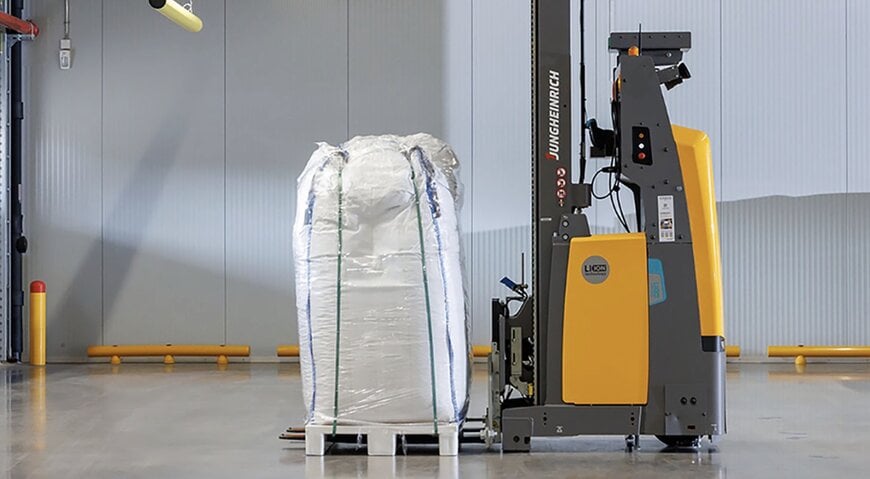
HELMA Kartoffelvertrieb is a wholesale distributor of food products based in Sittensen, Germany, specialising in the handling and distribution of potatoes. In its filling and warehouse areas, the company manages frequent pallet movements between production, storage and dispatch zones.
To improve efficiency and reduce manual handling, HELMA decided to automate part of its internal transport processes. The objective was to introduce a simple, reliable automation solution that could deliver immediate operational benefits while remaining scalable for future expansion.
Manual transport as a bottleneck in daily operations
Before automation, palletised transport between filling stations, storage areas and dispatch relied largely on manual handling. Even over relatively short distances, this created workload peaks, limited transparency and tied up personnel who were needed elsewhere in operations.
HELMA therefore focused on automating a clearly defined and repetitive transport task as a first step, allowing the company to assess the benefits of automation without introducing unnecessary complexity.
Mobile robot for palletised transport
HELMA implemented a mobile robot solution from Jungheinrich, centred on a single automated guided vehicle designed for pallet handling. The vehicle operates along a 120-metre transport route connecting filling stations, conveyor systems, block storage zones and dispatch areas.
The mobile robot transfers pallets from conveyor belts or floor-level stations to two block storage areas, moves goods between conveyor interfaces and supplies the filling process with empty pallets. By integrating these tasks into one automated flow, HELMA established a stable and predictable internal transport process.
Simple system integration and operation
The solution was implemented as a stand-alone system and connected to HELMA’s existing conveyor technology via a dedicated interface. It is powered by lithium-ion batteries and includes an automatic charging function, allowing continuous operation without manual intervention.
A web-based logistics interface provides visualisation and control of transport orders. Employees can start, monitor or cancel tasks via a tablet, reducing training requirements and simplifying daily operation.
According to Florian Brunkhorst, Head of IT at HELMA, even a single automated vehicle has delivered noticeable simplification while ensuring safe and reliable pallet transport.
Scalable foundation for future automation
The project marks HELMA’s entry into automated internal transport. By starting with one mobile robot and a clearly defined use case, the company has created a scalable foundation for expanding automation to additional material handling processes in the future.
For HELMA, the solution demonstrates how targeted intralogistics automation can improve efficiency and transparency in food distribution environments without disrupting existing operations. The project also highlights how modular mobile robot systems can be introduced incrementally, supporting long-term automation strategies in warehouse and filling operations.
www.jungheinrich.com
