
www.intralogisticsmag.com
26
'26
Written on Modified on
Exotec Deploys Multi-Site Warehouse Automation Program with Decathlon
Skyfleet program standardizes robotic intralogistics across seven European sites, improving throughput, scalability, and operator conditions through unified system architecture.
www.exotec.com
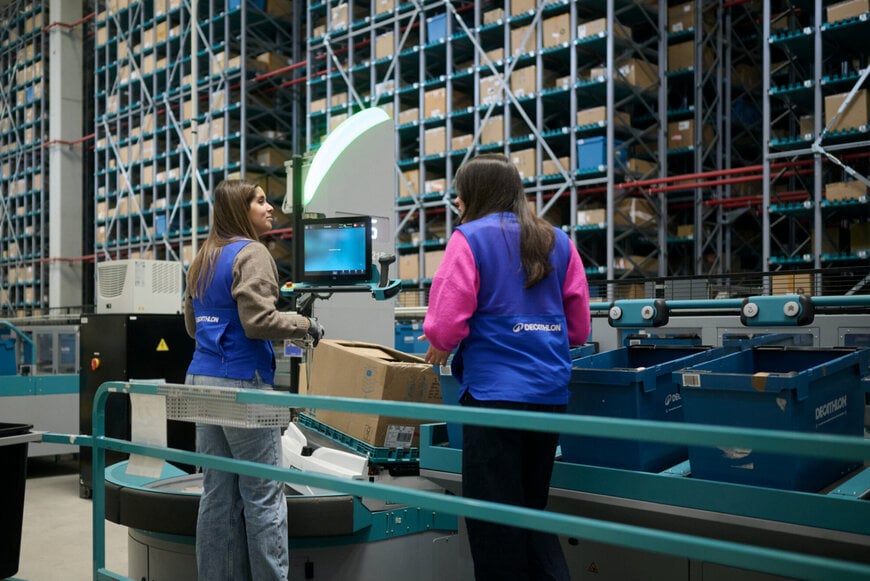
Retail logistics, e-commerce fulfilment, and large-scale distribution networks require synchronized automation to manage high volumes across multiple locations. At LogiMAT 2026 in Stuttgart (24–26 March), Exotec presented its Skyfleet® program, a multi-site warehouse automation deployment developed for Decathlon, designed to standardize and scale intralogistics operations across Europe.
Multi-site standardization for European logistics networks
The Skyfleet program spans seven warehouse sites across France, the United Kingdom, Portugal, Italy, and Germany. It is based on a unified system architecture that enables consistent deployment, operation, and maintenance across geographically distributed facilities.
Each site follows a standardized configuration built around Exotec’s Skypod® robotic system, supporting both inbound and outbound logistics processes within a single framework. This approach reduces engineering complexity during deployment and allows faster replication of warehouse designs across multiple locations.
Typical system configurations include fleets of 150 to 200 robots, storage capacities of up to 125,000 locations, and throughput levels reaching 4,000 order lines per hour. Daily handling capacity can reach up to 200,000 items, depending on site requirements and configuration.
Integrated automation and warehouse execution system
Beyond robotic storage and retrieval, each facility integrates additional automated equipment such as depalletizers, carton opening machines, RFID tunnels, and palletizing systems. Standardizing these components across multiple sites reduces system design time and simplifies supplier selection.
Operational coordination is managed by Deepsky®, Exotec’s warehouse execution system (WES), which orchestrates material flows and synchronizes all automated subsystems. A shared software codebase across all sites ensures consistency in system behavior while enabling centralized updates and performance optimization.
This integration supports end-to-end automation, from goods receipt to order preparation and shipping, within a unified digital and physical infrastructure.
Performance gains in throughput and store replenishment
The standardized architecture has enabled measurable improvements in logistics performance. Several sites have significantly increased the number of retail stores they supply, supporting broader distribution coverage without proportional increases in infrastructure.
Throughput gains are also evident. For example, one facility doubled its daily order preparation capacity from approximately 57,000 to 114,000 orders after implementing the Skyfleet system. These improvements reflect both increased automation and optimized process flows enabled by system standardization.
The system is also designed for scalability. Robot fleets can be expanded incrementally, and resources can be redistributed between sites during peak demand periods, providing operational flexibility across the network.
Impact on operator efficiency and working conditions
The goods-to-person model implemented in Skyfleet reduces manual travel and physical strain for warehouse operators. In one deployment, daily walking distance for pickers decreased from approximately 10 km to 1 km, illustrating the impact of automation on labor efficiency.
This reduction in manual movement contributes to improved ergonomics and can support lower incident rates in picking operations. Standardized system interfaces and workflows also simplify training, enabling faster onboarding and skill development across multiple sites.
Positioning within large-scale warehouse automation
Multi-site automation programs are increasingly adopted by large retailers seeking to harmonize logistics operations. Comparable solutions are offered by companies such as AutoStore and Ocado Group, which also focus on scalable robotic systems and centralized control architectures.
Exotec differentiates its approach through its dual role as both original equipment manufacturer (OEM) and system integrator, delivering a complete solution that combines robotics, software, and system design. The Skyfleet program illustrates how standardized automation architectures can be deployed across multiple sites while maintaining flexibility for local operational requirements.
By enabling consistent system performance, centralized optimization, and scalable deployment, the program demonstrates a model for managing complex European supply chains using integrated warehouse automation technologies.
Edited by Natania Lyngdoh, Induportals Editor — Adapted by AI.
www.exotec.com
