
www.intralogisticsmag.com
13
'25
Written on Modified on
Efficient Packing with Basler’s Volume Measurement
Stereo and ToF cameras ensure precise package sizing and optimal pallet loading.
www.baslerweb.com
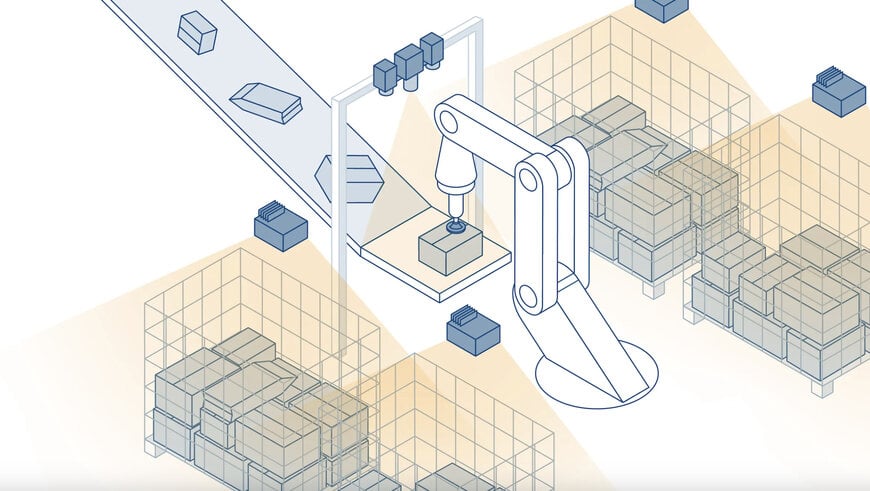
Packing pallet cages, pallets and other load carriers safely and efficiently is a key task in outbound logistics. Precise volume recording of parcels and goods helps to make optimum use of the available loading space and ensure smooth onward distribution. The stereo and time-of-flight camera technology measures packages precisely, detects gaps in pallet cages and thus enables optimum packing. A robot carries out all process steps autonomously.
The basis for the packing process is sorting according to postal routing codes
Parcels and goods that go the last mile for delivery must be sorted by destination region. This information is contained in postal routing codes, which are included in barcodes and QR codes for digitally created shipping labels.
Stereo vision for maximum precision, time-of-flight technology for efficiency
The parcels, identified by their target region, are routed onto a storage surface. There they are measured and localized using stereo technology. A logistics robot picks up the parcel and a second 3D camera with ToF technology determines the appropriate place in the pallet cage intended for the respective target region. This allows the logistics robot to optimally load the pallet cage.
Dimensioning accurate to the millimeter thanks to Stereo Vision
With a distance of 150 cm, the 3D stereo ace camera is STA-200-547M-082616-W sensor above the storage area. It measures the package and, in the next step, determines a suitable packing position in the pallet cage based on the dimensions.
In combination with the industrial computer that processes the 3D data, dimensioning takes less than 200 ms. This is necessary to achieve a correspondingly short processing time. We recommend providing GPU support in the computing architecture.
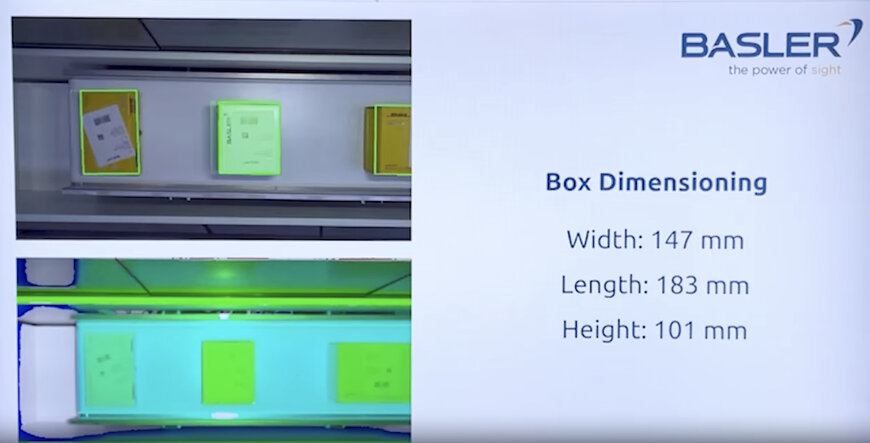
The Stereo ace camera determines the length, width and height of the parcels in less than 200 ms
Damage-free gripping thanks to exact localization of the package surface
The 3D depth data from the stereo ace camera also provides precise positioning of the parcels. Compared to other 3D methods, the stereo vision technology enables even with varying surfaces the most precise detection of the top edge. This allows the robot's vacuum grippers to grip the parcels safely and without risk of damage.
The key to the highest precision in edge detection lies in the random dot projector, which is already integrated in the stereo ace camera: a projector projects a random pattern of dots onto the recording scene. This creates texture when little or no structure is present.
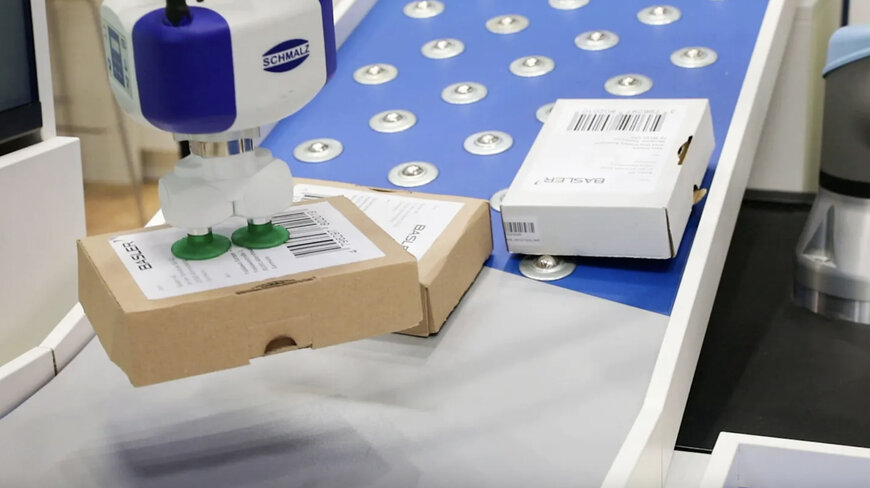
By precisely recording the x, y and z coordinates of the delivered parcels, the robot can grip them reliably and damage-free.
Efficient packing: Fill level detection with time-of-flight technology
3D time-of-flight cameras are installed above the parcel cages, which measure the remaining space in the cages in real time. This data is compared with the dimensions of the package just picked up and a suitable gap or the most efficient packing space possible is sought for each package. As this process step requires significantly less accuracy, the Basler ToF Camera with -102 nm a more cost-effective 3D technology can be used.
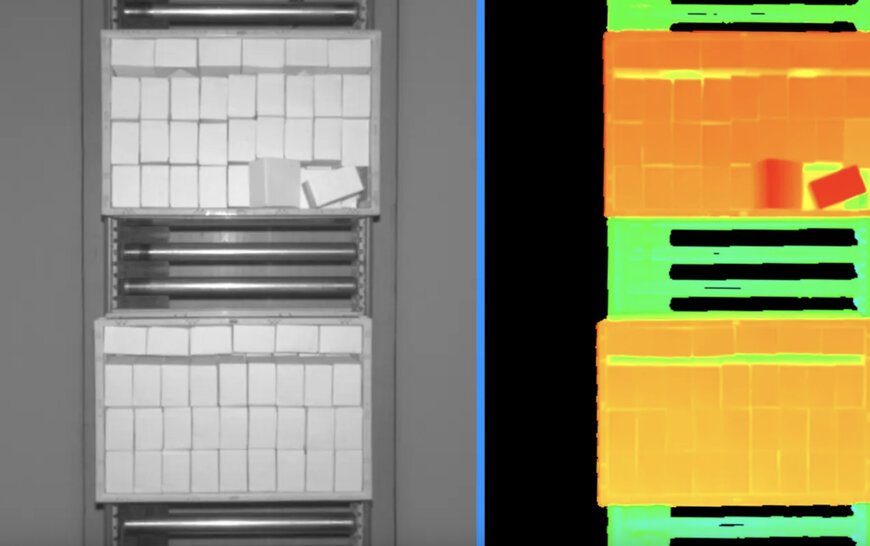
Correctly loaded Eurobox (small load carrier) and Eurobox with protruding cardboard packaging: The 3D height image (right) makes height differences and gaps visible.
www.baslerweb.com
