
www.intralogisticsmag.com
23
'26
Written on Modified on
HAVI Group and Carrier Transicold implement Vector eCool systems in temperature-controlled logistics
Carrier Transicold and HAVI Group collaborate to deploy autonomous electric refrigeration systems on semi-trailers to improve cold chain operational efficiency and reduce emissions across logistics operations.
www.carrier.com
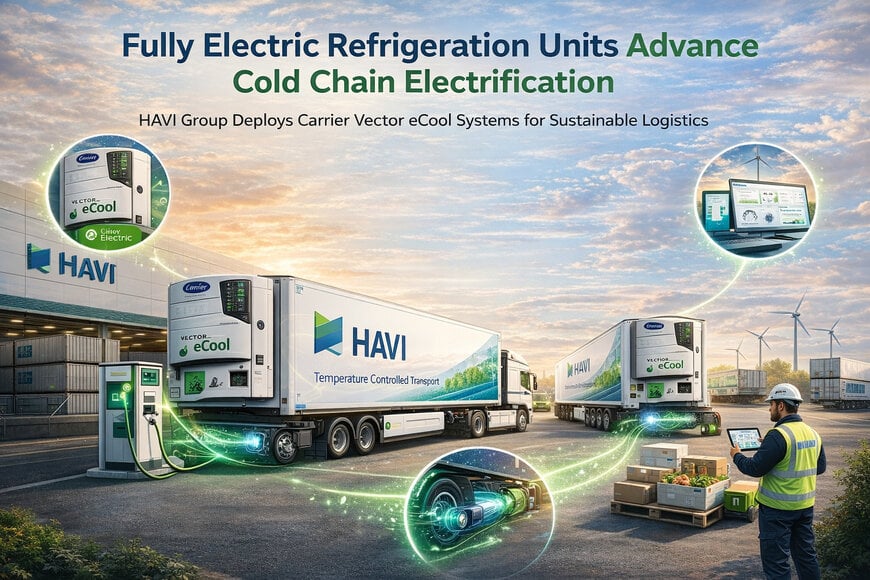
HAVI Group has integrated two Carrier Transicold Vector eCool systems into its refrigerated trailer fleet, introducing fully electric refrigeration units for temperature-sensitive goods transport and advancing cold chain electrification in logistics applications. The deployment follows successful technical evaluations of the all-electric solution in pilot operations.
Context of the Cooperation
HAVI Group is a global supply chain solutions provider focused on food service logistics. Carrier Transicold, part of Carrier Global Corporation, specialises in transport refrigeration equipment for cold chain logistics. HAVI’s operations face the industry-wide challenge of decarbonising temperature-controlled transport while maintaining strict thermal control and reliability for perishable products. Cooperation was necessary to integrate an electric trailer refrigeration solution that addresses emissions, noise, and maintenance constraints inherent in traditional diesel-powered units.
Technical Solution and Division of Responsibilities
The technical core of the cooperation is the Carrier Transicold Vector eCool, a fully electric, engineless refrigeration system designed for semi-trailers. Unlike traditional Transport Refrigeration Units (TRUs) that rely on internal combustion engines, the Vector eCool uses an integrated energy regeneration and storage architecture that captures kinetic energy during trailer movement and stores it in onboard batteries. This stored energy powers the refrigeration compressor and cooling system, enabling continuous temperature control without combustion emissions.
Carrier Transicold provided the eCool system design, integration support, and system calibration. HAVI Group defined operational requirements and portfolio integration criteria, including compatibility with existing semi-trailer platforms and cold chain workflows. Addvolt and SAF-Holland contributed energy management components and generator axle integration, supporting the all-electric architecture.
Deployment and Implementation
The Vector eCool systems have been installed on two semi-trailers in HAVI’s fleet, operating primarily between logistics centres and client restaurant locations. The deployment leverages the eCool system’s autonomous electric refrigeration capability, which functions even when the trailer is stationary or disconnected from grid power. The units can recharge from external power when parked, meeting operational demands without additional fossil fuel inputs.
The implementation follows a pilot phase conducted in Portugal, where eCool technology demonstrated sustained temperature control and operational feasibility under real logistics conditions. System integration involved calibrating temperature set points, validating battery state-of-charge algorithms, and establishing data interfaces for telematics monitoring.
Applications and Use Cases
The solution addresses cold chain applications in food service distribution, where maintaining stable refrigerated conditions (e.g., 2–8 °C) is critical for product quality and regulatory compliance. Because the eCool system eliminates diesel engine operation, it also reduces noise and emissions in urban and sensitive delivery environments, contributing to compliance with low-emission zone regulations.
Expected Impact
Electrifying trailer refrigeration is expected to deliver several measurable benefits: reduced lifecycle greenhouse gas emissions, lower maintenance requirements due to the absence of a combustion engine, and quieter operation. Operational efficiency gains arise from energy recovered during motion and reduced reliance on external fuel sources. While specific performance figures for this deployment were not disclosed, the solution’s design indicates significant reductions in direct emissions and fuel costs compared to conventional TRUs.
Partner Insights
In context, technical deployments such as this illustrate how cross-industry cooperation combining vehicle energy regeneration, electric refrigeration technology, and logistics integration expertise can address complex cold chain decarbonisation goals without compromising thermal performance.
www.carrier.com
Context of the Cooperation
HAVI Group is a global supply chain solutions provider focused on food service logistics. Carrier Transicold, part of Carrier Global Corporation, specialises in transport refrigeration equipment for cold chain logistics. HAVI’s operations face the industry-wide challenge of decarbonising temperature-controlled transport while maintaining strict thermal control and reliability for perishable products. Cooperation was necessary to integrate an electric trailer refrigeration solution that addresses emissions, noise, and maintenance constraints inherent in traditional diesel-powered units.
Technical Solution and Division of Responsibilities
The technical core of the cooperation is the Carrier Transicold Vector eCool, a fully electric, engineless refrigeration system designed for semi-trailers. Unlike traditional Transport Refrigeration Units (TRUs) that rely on internal combustion engines, the Vector eCool uses an integrated energy regeneration and storage architecture that captures kinetic energy during trailer movement and stores it in onboard batteries. This stored energy powers the refrigeration compressor and cooling system, enabling continuous temperature control without combustion emissions.
Carrier Transicold provided the eCool system design, integration support, and system calibration. HAVI Group defined operational requirements and portfolio integration criteria, including compatibility with existing semi-trailer platforms and cold chain workflows. Addvolt and SAF-Holland contributed energy management components and generator axle integration, supporting the all-electric architecture.
Deployment and Implementation
The Vector eCool systems have been installed on two semi-trailers in HAVI’s fleet, operating primarily between logistics centres and client restaurant locations. The deployment leverages the eCool system’s autonomous electric refrigeration capability, which functions even when the trailer is stationary or disconnected from grid power. The units can recharge from external power when parked, meeting operational demands without additional fossil fuel inputs.
The implementation follows a pilot phase conducted in Portugal, where eCool technology demonstrated sustained temperature control and operational feasibility under real logistics conditions. System integration involved calibrating temperature set points, validating battery state-of-charge algorithms, and establishing data interfaces for telematics monitoring.
Applications and Use Cases
The solution addresses cold chain applications in food service distribution, where maintaining stable refrigerated conditions (e.g., 2–8 °C) is critical for product quality and regulatory compliance. Because the eCool system eliminates diesel engine operation, it also reduces noise and emissions in urban and sensitive delivery environments, contributing to compliance with low-emission zone regulations.
Expected Impact
Electrifying trailer refrigeration is expected to deliver several measurable benefits: reduced lifecycle greenhouse gas emissions, lower maintenance requirements due to the absence of a combustion engine, and quieter operation. Operational efficiency gains arise from energy recovered during motion and reduced reliance on external fuel sources. While specific performance figures for this deployment were not disclosed, the solution’s design indicates significant reductions in direct emissions and fuel costs compared to conventional TRUs.
Partner Insights
In context, technical deployments such as this illustrate how cross-industry cooperation combining vehicle energy regeneration, electric refrigeration technology, and logistics integration expertise can address complex cold chain decarbonisation goals without compromising thermal performance.
www.carrier.com
