
www.intralogisticsmag.com
11
'26
Written on Modified on
Modular Intralogistics Automation Systems for Scalable Warehousing
Kardex presents integrated hardware, software, and lifecycle services for automated storage, picking, and warehouse control at LogiMAT 2026 in Stuttgart.
www.kardex.com
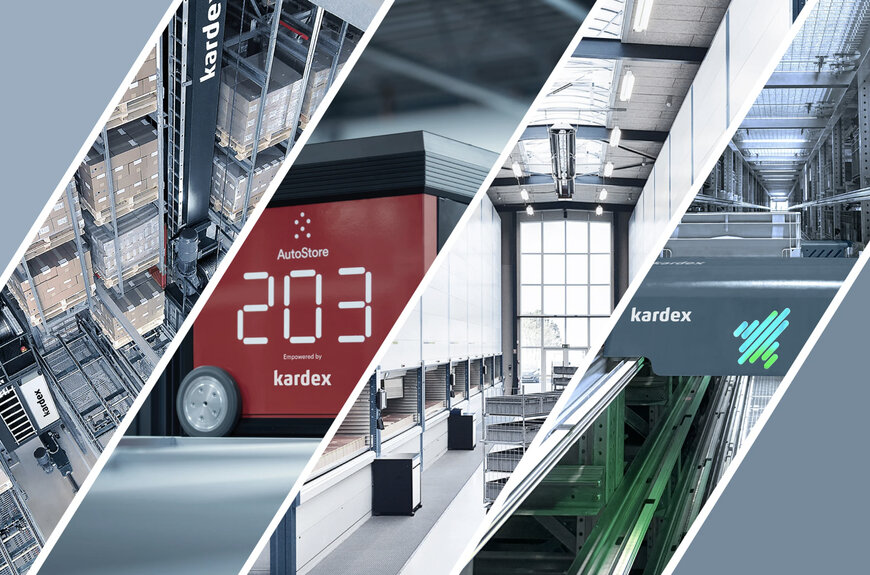
Automated storage and retrieval technologies are evolving toward modular architectures that combine hardware, software, and lifecycle services. At LogiMAT 2026 in Stuttgart, Kardex presented a portfolio of automated intralogistics systems designed to support scalable warehouse automation for small parts, bins, and pallets.
Modular Automation for Small Parts and Bin Handling
At the intralogistics trade show LogiMAT, held in Stuttgart, Germany from 24–26 March 2026, Kardex demonstrated how modular systems and digital supply chain software can be integrated to automate storage and picking processes across different warehouse environments. The solutions target manufacturers, distribution centers, and logistics providers managing small parts, bins, and palletized goods.
One of the systems presented was a redesigned vertical lift module, the Kardex Shuttle, equipped with an updated control system. The system was demonstrated together with the Intuitive Pick Assistant, a projection-based guidance technology that displays picking information directly at the storage location. By visually guiding operators to the correct item and quantity, the system reduces manual search time and supports error reduction during order picking.
Projection-assisted picking systems are commonly used in environments where high picking accuracy and short training times are required. By displaying item location, quantity, and confirmation signals directly at the access point, the technology enables operators to process orders more efficiently while maintaining traceability within warehouse management workflows.
Ergonomic Workstations and Hands-Free Operation
Process optimization at the workstation level was demonstrated through the integration of a compact bin storage system and wearable guidance technology. The Kardex Miniload-in-a-Box system stores small parts in bins and delivers them to operators using an automated handling mechanism that presents items via a rotating turntable.
The workstation can be paired with the Wearable Task Assistant, a device that provides hands-free operational support. The assistant integrates a barcode scanner, wrist-mounted display, and visual task instructions. Color-coded signals on the wearable interface guide operators through picking and placement tasks, allowing both hands to remain free for handling items.
This configuration is designed for environments transitioning from manual processes to partial automation. By combining automated bin delivery with wearable picking guidance, the system aims to improve picking accuracy while reducing ergonomic strain and process errors.
AutoStore-Based High-Performance Picking
For high-throughput operations, Kardex demonstrated workstation technology designed for robotic bin storage systems. The Kardex Smart Workstation integrates with AutoStore-based storage grids and supports picking operations through guided workflows.
The workstation includes several integrated control mechanisms such as pick-to-light guidance, weight verification, and traceability functions. Weight verification compares expected and measured item weights to confirm that the correct quantity has been picked, reducing the likelihood of fulfillment errors.
Such workstation integrations are typically deployed in e-commerce and spare parts distribution environments where order accuracy and traceable picking processes are critical performance indicators.
Software Platform for Warehouse Visibility
In addition to hardware systems, Kardex presented its software ecosystem under the KardexOne platform. The platform connects warehouse machines, storage systems, and operational data to support centralized control and analytics.
Two software components were highlighted: the Kardex Power Pick Cloud and the Kardex Control Center. The Power Pick Cloud focuses on operational tasks such as order processing, picking workflows, and warehouse management functions. The Kardex Control Center provides system-level monitoring and control for material flow processes within automated storage environments.
By linking operational software with machine-level data, the platform enables warehouse operators to track system status, manage orders, and analyze storage and retrieval processes across multiple installations.
Data-Driven Lifecycle Services
Kardex also presented lifecycle services designed to maintain performance and availability of automated intralogistics systems. These services rely on connected monitoring tools that provide real-time operational insights.
The Kardex Connect system supports remote diagnostics and service management. According to Kardex, more than 80 percent of service cases can be resolved remotely through this connectivity, reducing the need for on-site maintenance visits. The platform integrates machine monitoring, automated service requests, and a Machine Health Dashboard displaying performance data, error logs, and maintenance history.
Complementing this service infrastructure, Kardex Analytics provides warehouse managers with analytical tools for evaluating operational performance. The software processes warehouse data such as order lines, picking activities, and storage transactions to generate performance reports. Exportable datasets allow operators to identify operational bottlenecks and implement improvements in storage utilization or picking efficiency.
Automation as a Connected Warehouse Ecosystem
The technologies presented illustrate how modern intralogistics systems are evolving into connected operational ecosystems. By combining modular storage systems, guided picking technologies, warehouse control software, and lifecycle analytics, warehouse operators can integrate automation gradually while maintaining operational transparency.
Such integrated approaches support the transition toward digital supply chain environments where storage, picking, and maintenance processes are increasingly managed through connected platforms and data-driven optimization.
Edited by , Sucithra Mani — AI-powered.
www.kardex.com
