
www.intralogisticsmag.com
27
'26
Written on Modified on
Robotic Intralogistics Systems for Warehouse Automation
FANUC America showcases AI-enabled robotic solutions at MODEX 2026 to improve box handling, palletizing, and autonomous material movement in warehouse environments.
www.fanuc.eu
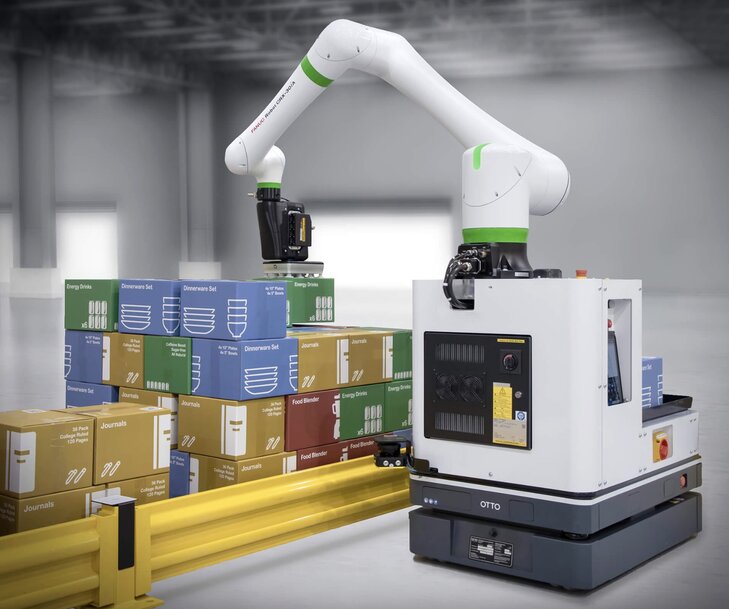
At MODEX 2026 (April 13–16, Atlanta, USA), FANUC America is presenting robotic systems designed for intralogistics and warehouse automation. The demonstrations focus on integrating robotics, AI-based vision, and autonomous mobile systems to address labor shortages, improve throughput, and enhance operational safety.
AI-enabled robotics for dynamic warehouse environments
The showcased systems combine industrial and collaborative robots with AI-driven perception tools to handle variable workloads in logistics operations. Vision systems and intelligent algorithms enable robots to identify objects, interpret barcodes, and adapt to changing conditions such as mixed box sizes and irregular pallet configurations.
These capabilities support real-time decision-making in environments where product variability and throughput requirements demand flexible automation.
Mobile manipulation for palletizing and transport
A central demonstration features a collaborative mobile manipulator that integrates a high-payload robot with an autonomous mobile robot (AMR) platform. This system performs end-to-end tasks including picking, weighing, transporting, palletizing, and sorting of boxes.
AI-based perception tools—such as payload estimation, 3D vision-based box localization, and barcode-driven routing—enable adaptive handling across different product types and pallet conditions. The system operates at collaborative speeds while maintaining safety through area scanners and dynamic speed control, allowing human-robot interaction without physical barriers.
The AMR supports intralogistics workflows by transporting multiple boxes simultaneously and enabling continuous material flow between workstations.
Vision-guided scanning and identification workflows
Another demonstration highlights interactive box scanning using a collaborative robot equipped with 3D vision sensors. The system allows users to program inspection and barcode reading tasks through intuitive interfaces, including drag-and-drop programming and manual guidance.
This approach simplifies deployment and reduces the need for specialized programming expertise, making robotic inspection systems more accessible in warehouse environments.
Multi-SKU handling and tote consolidation
For fulfillment operations handling diverse product ranges, the system integrates 2D vision, 3D sensors, and radio-frequency identification (RFID) technology to identify and sort items. Robots use barcode data and spatial recognition to locate and pick items from bins, while RFID ensures accurate product identification.
This combination enables efficient consolidation of multiple stock keeping units (SKUs), supporting order accuracy and reducing manual sorting requirements in complex logistics workflows.
AI-supported palletizing and depalletizing
A further application demonstrates automated palletizing and depalletizing using AI-based box detection. Vision systems analyze complex stacking patterns and determine optimal pick positions, even when product arrangements are irregular or partially obscured.
The system also handles intermediate materials such as slip sheets between pallet layers, enabling fully automated pallet handling cycles. This reduces manual intervention and improves consistency in high-throughput environments.
Role in automated supply chain operations
The presented systems reflect broader trends in warehouse automation, where robotics, AI vision, and autonomous transport are increasingly combined to create flexible, scalable intralogistics solutions. By enabling adaptive handling, real-time analysis, and safe human-robot collaboration, these technologies support more efficient and resilient supply chain operations.
Edited by Romila DSilva, Induportals Editor, with AI assistance.
www.fanucamerica.com
