
www.intralogisticsmag.com
23
'26
Written on Modified on
Robotic palletizing integration for packaging automation
TRAPO presents integrated robotic handling systems to improve palletizing efficiency and process transparency in packaging and intralogistics applications.
www.trapo.de
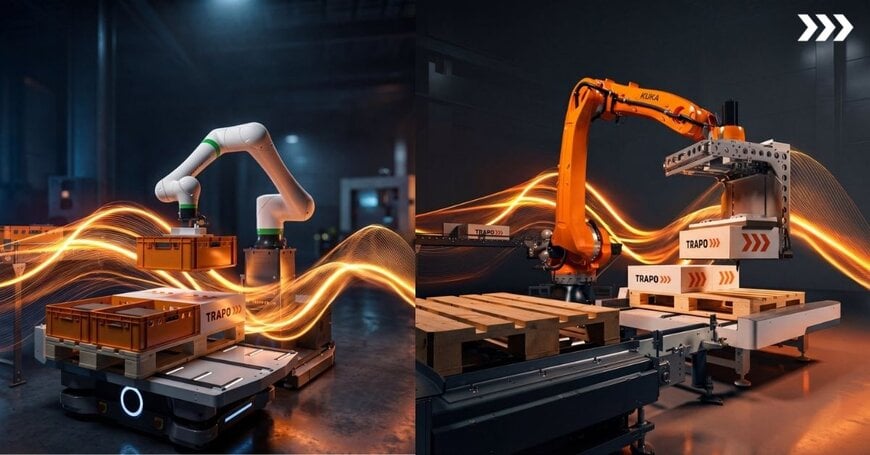
Under the motto “Dancing with Robots,” TRAPO presents a live application at interpack 2026 showcasing high-performance crate and carton handling with robots and conveyor technology in perfectly synchronized operation.
Packaging automation and intralogistics systems are evolving toward higher levels of integration, combining robotics, conveyor technology, and software-based control. At interpack 2026 (7–13 May), TRAPO demonstrated a coordinated robotic handling system designed for crate and carton palletizing in industrial environments.
Integrated robotics for synchronized handling
The system focuses on handling reusable crates and cartons weighing up to 35 kg, a typical requirement in packaging and distribution operations. It combines two articulated robots—a collaborative robot (cobot) and a high-speed industrial robot—working in synchronization with conveyor systems and an autonomous mobile robot (AMR).
The cobot, equipped with a suction gripper, is designed for flexible and low-maintenance handling tasks, while the high-speed robot uses a fork gripper for precise palletizing and depalletizing. Both robots alternate operations on longitudinal and transverse pallets, ensuring continuous material flow.
A separate autonomous robot manages pallet exchange, enabling operation in constrained spaces where manual intervention would reduce efficiency. This configuration illustrates how multi-robot coordination can stabilize throughput while maintaining accuracy in stacking operations.
Gripper technology as a performance factor
The system’s performance relies significantly on application-specific gripper design. Grippers are engineered according to object geometry, weight distribution, and required cycle times, ensuring stable handling and minimizing positioning errors.
This approach allows consistent stacking precision, particularly when crates must be nested accurately. By aligning gripper capabilities with robot kinematics and process requirements, the system reduces handling variability and supports repeatable operations.
Digital control and process transparency
All modules—robots, conveyors, and AMRs—are connected through TRAPO Intelligent Management, a software platform acting as a central control layer. The system coordinates material flow, monitors operational status, and records process data in real time.
This enables calculation of key performance indicators such as Overall Equipment Effectiveness (OEE), while also improving fault detection and process optimization. Sensor integration and control logic contribute to stable and safe operation, particularly in mixed automation environments.
Flexible deployment in limited space
The system is designed to operate in environments with restricted floor space. In addition to fixed conveyor infrastructure, mobile automation solutions are presented, including a compact cobot-based palletizing unit.
This mobile system can be deployed with minimal installation effort and supports flexible production layouts. Its transportable design allows integration into existing facilities without major structural modifications, addressing common constraints in retrofitting scenarios.
Application areas in packaging and intralogistics
The demonstrated system targets industries requiring automated handling of packaged goods, including food and beverage, logistics, and consumer goods manufacturing. Typical use cases include palletizing, depalletizing, and internal material transport.
By combining robotics, digital control, and modular system design, the solution addresses the need for scalable automation in dynamic production environments. The integration of real-time data monitoring further supports continuous improvement in operational efficiency.
Edited by an industrial journalist, Lekshman Ramdas, with AI assistance.
www.trapo.com
Packaging automation and intralogistics systems are evolving toward higher levels of integration, combining robotics, conveyor technology, and software-based control. At interpack 2026 (7–13 May), TRAPO demonstrated a coordinated robotic handling system designed for crate and carton palletizing in industrial environments.
Integrated robotics for synchronized handling
The system focuses on handling reusable crates and cartons weighing up to 35 kg, a typical requirement in packaging and distribution operations. It combines two articulated robots—a collaborative robot (cobot) and a high-speed industrial robot—working in synchronization with conveyor systems and an autonomous mobile robot (AMR).
The cobot, equipped with a suction gripper, is designed for flexible and low-maintenance handling tasks, while the high-speed robot uses a fork gripper for precise palletizing and depalletizing. Both robots alternate operations on longitudinal and transverse pallets, ensuring continuous material flow.
A separate autonomous robot manages pallet exchange, enabling operation in constrained spaces where manual intervention would reduce efficiency. This configuration illustrates how multi-robot coordination can stabilize throughput while maintaining accuracy in stacking operations.
Gripper technology as a performance factor
The system’s performance relies significantly on application-specific gripper design. Grippers are engineered according to object geometry, weight distribution, and required cycle times, ensuring stable handling and minimizing positioning errors.
This approach allows consistent stacking precision, particularly when crates must be nested accurately. By aligning gripper capabilities with robot kinematics and process requirements, the system reduces handling variability and supports repeatable operations.
Digital control and process transparency
All modules—robots, conveyors, and AMRs—are connected through TRAPO Intelligent Management, a software platform acting as a central control layer. The system coordinates material flow, monitors operational status, and records process data in real time.
This enables calculation of key performance indicators such as Overall Equipment Effectiveness (OEE), while also improving fault detection and process optimization. Sensor integration and control logic contribute to stable and safe operation, particularly in mixed automation environments.
Flexible deployment in limited space
The system is designed to operate in environments with restricted floor space. In addition to fixed conveyor infrastructure, mobile automation solutions are presented, including a compact cobot-based palletizing unit.
This mobile system can be deployed with minimal installation effort and supports flexible production layouts. Its transportable design allows integration into existing facilities without major structural modifications, addressing common constraints in retrofitting scenarios.
Application areas in packaging and intralogistics
The demonstrated system targets industries requiring automated handling of packaged goods, including food and beverage, logistics, and consumer goods manufacturing. Typical use cases include palletizing, depalletizing, and internal material transport.
By combining robotics, digital control, and modular system design, the solution addresses the need for scalable automation in dynamic production environments. The integration of real-time data monitoring further supports continuous improvement in operational efficiency.
Edited by an industrial journalist, Lekshman Ramdas, with AI assistance.
www.trapo.com
