
www.intralogisticsmag.com
07
'26
Written on Modified on
Ring Scanners Support Hands-Free Warehouse Operations
Ring scanners use wearable barcode scanning technology to improve productivity, mobility, and workflow efficiency in warehouse and logistics environments.
www.mecalux.com
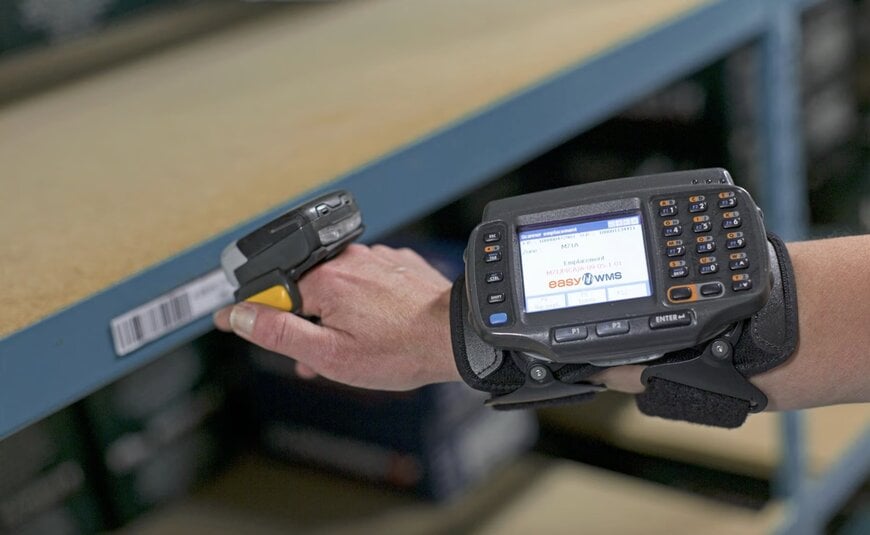
Ring scanners are wearable data-capture devices designed to support hands-free barcode scanning in warehouses, retail facilities, and industrial operations. Worn on a worker’s finger and secured with a strap, the devices enable operators to scan barcodes while keeping their hands available for handling products, pallets, or equipment.
The technology is commonly used in order picking, packing, replenishment, sorting, and cross-docking applications where operational speed and worker mobility are important. Ring scanners are available from manufacturers including Zebra, Honeywell, and Unitech, and are designed to withstand intensive daily use in industrial environments.
Hands-Free Barcode Scanning
Unlike conventional handheld RF scanners, ring scanners are intended for continuous hands-free operation. The device is typically worn on the index or middle finger and uses laser or imaging technology to capture barcode data.
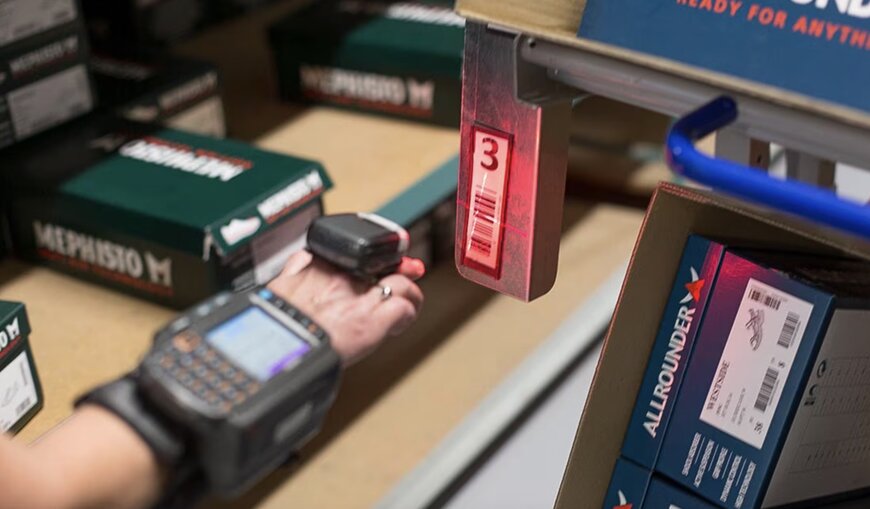
Workers scan a barcode by pointing the finger-mounted scanner toward the code. The scanned data is then transmitted wirelessly, commonly through Bluetooth, to a mobile computer or wearable terminal connected to warehouse software systems. Feedback confirming successful scans is usually provided through audible, visual, or vibration signals.
According to the article, ring scanners can also integrate with pick-by-vision and voice-picking systems to support warehouse workflows.
Types of Ring Scanners
Ring scanners are generally categorized according to the scanning technology used.
1D Ring Scanners
These devices use laser-based scanning technology that reads linear barcodes by measuring reflected light intensity. They are designed for 1D barcode applications and cannot read QR codes or other two-dimensional formats.
2D Ring Scanners
2D ring scanners use image sensors, typically CMOS-based, to capture barcode information similarly to a digital camera. These systems can read both 1D barcodes and 2D codes such as QR codes from multiple angles.
Mid- and Long-Range Ring Scanners
Some ring scanners are equipped with optics or lighting systems that support scanning from greater distances. These models are commonly used in warehouse environments where operators may need to scan rack locations or pallet labels without leaving forklifts or workstations.
Operational Benefits
According to the article, ring scanners can improve operational efficiency by reducing the need for workers to repeatedly pick up and set down handheld scanning devices.
Key operational benefits include:
- Hands-free operation during material handling tasks
- Faster order-picking workflows
- Increased scanning throughput
- Reduced risk of device drops or damage
- Limitations and Operational Considerations
Despite operational advantages, ring scanners have several limitations.
The compact form factor can reduce battery capacity, requiring charging management during long shifts or continuous operation. Components such as trigger buttons and fastening straps may also experience wear over time in demanding warehouse environments.
Some models are optimized for short-range scanning, which may limit their suitability for certain warehouse layouts or applications.
Deployment in Warehouse Operations
French fashion brand Rouje upgraded its logistics processes by deploying Easy WMS in its Palaiseau warehouse. Digitalisation improved omnichannel order fulfilment for both online customers and retail shops.
Workers now utilise ring or RF scanners to capture barcode data quickly and accurately. The system assigns tasks and distributes workloads across the team. With this setup, the scanner is worn on the employee’s finger, while the mobile device is secured to their arm. Thanks to Easy WMS’s organisational and digital support, Rouje increased picking productivity by 20%.
Additional Context
Wearable scanning technologies are increasingly used in warehouse and logistics operations to support faster order fulfilment and reduce operator movement during repetitive tasks. Ring scanners form part of a broader category of wearable warehouse technologies that also includes wrist-mounted terminals, voice-picking systems, and smart glasses.
Barcode scanning remains a core element of warehouse traceability and inventory management. The adoption of 2D barcode systems and QR codes has expanded the functionality of scanning devices, particularly in environments requiring higher data density and faster processing.
Warehouse management systems (WMS) commonly integrate with wearable scanning technologies to coordinate task assignment, inventory tracking, and order fulfilment processes. In high-volume ecommerce and distribution operations, wearable devices are often used to support productivity improvements and reduce picking errors.
Edited by Romila DSilva, Induportals Editor, with AI assistance.
The compact form factor can reduce battery capacity, requiring charging management during long shifts or continuous operation. Components such as trigger buttons and fastening straps may also experience wear over time in demanding warehouse environments.
Some models are optimized for short-range scanning, which may limit their suitability for certain warehouse layouts or applications.
Deployment in Warehouse Operations
French fashion brand Rouje upgraded its logistics processes by deploying Easy WMS in its Palaiseau warehouse. Digitalisation improved omnichannel order fulfilment for both online customers and retail shops.
Workers now utilise ring or RF scanners to capture barcode data quickly and accurately. The system assigns tasks and distributes workloads across the team. With this setup, the scanner is worn on the employee’s finger, while the mobile device is secured to their arm. Thanks to Easy WMS’s organisational and digital support, Rouje increased picking productivity by 20%.
Additional Context
Wearable scanning technologies are increasingly used in warehouse and logistics operations to support faster order fulfilment and reduce operator movement during repetitive tasks. Ring scanners form part of a broader category of wearable warehouse technologies that also includes wrist-mounted terminals, voice-picking systems, and smart glasses.
Barcode scanning remains a core element of warehouse traceability and inventory management. The adoption of 2D barcode systems and QR codes has expanded the functionality of scanning devices, particularly in environments requiring higher data density and faster processing.
Warehouse management systems (WMS) commonly integrate with wearable scanning technologies to coordinate task assignment, inventory tracking, and order fulfilment processes. In high-volume ecommerce and distribution operations, wearable devices are often used to support productivity improvements and reduce picking errors.
Edited by Romila DSilva, Induportals Editor, with AI assistance.
