
www.intralogisticsmag.com
16
'26
Written on Modified on
Smarter Warehouse Trucks for High-Density Operations
STILL introduces upgraded stackers and pallet trucks with advanced safety, speed control, and fleet connectivity.
www.still.fr
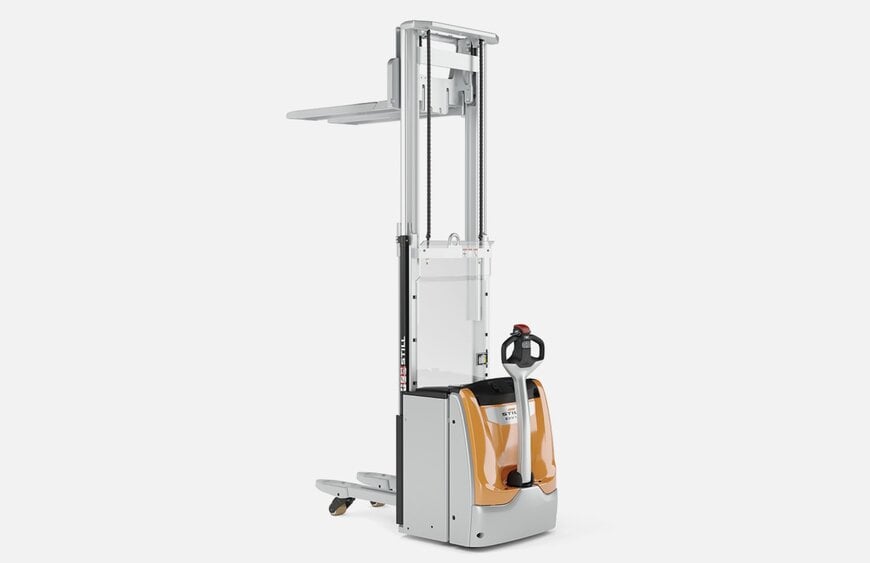
STILL is releasing upgraded versions of its electric stackers and pallet trucks to address the rigorous demands of high-density warehouse operations and distribution centers. These material handling solutions integrate intelligent speed control, structural safety features, and fleet management telemetry to support the digital supply chain across tight storage aisles and long-distance horizontal transport applications.
Adapting Hardware for the Digital Supply Chain
The deployment of the upgraded EXV 14-20 and EXP 14-20 stackers, alongside the EXH 14 and EXH-S 20-25 pallet trucks, addresses the operational challenge of maximizing storage density without compromising retrieval times. As warehouse layouts become more compressed, operators require equipment that minimizes the necessary turning radius while maintaining high load capacities. Marco Fornara, Head of Sales & Marketing Support at STILL Italy, noted that rapid shifts in industrial requirements necessitate the continuous development of hardware and the integration of evolving technologies to match specific operational parameters.
Horizontal Transport and Automated Safety Mechanisms
For horizontal transport, the EXH-S 20-25 rider pallet truck provides a load capacity of 2,500 kg and reaches a maximum travel speed of 14 km/h, designed specifically for long-distance facility logistics. The unit incorporates a chassis-integrated SafetyLight system and a steering tiller with an embedded display. To mitigate crush hazards, an intelligent foot sensor utilizes spatial detection to either immobilize the equipment or restrict its speed if the operator's feet exit the designated platform footprint. Furthermore, the unit connects directly to the STILL Smart Portal fleet management system to track utilization metrics.
For localized transport tasks, the EXH 14 pedestrian pallet truck offers a 1,400 kg capacity. Its compact dimensional profile allows it to maneuver inside delivery truck cargo compartments and navigate constrained staging areas even when the tiller is fully extended.
High-Rack Storage Maneuverability and Speed Control
The EXV 14-20 and EXP 14-20 pedestrian stackers are engineered for vertical load handling, supporting capacities up to 2,000 kg. The stackers utilize an OptiSpeed function, an electromechanical mechanism that automatically scales the travel speed in direct proportion to the tiller angle, ensuring a standardized safety distance between the chassis and the operator. This system functions alongside a Curve Speed Control architecture, which governs acceleration and braking forces during cornering to prevent load destabilization.
The EXV 14-20 is structurally configured for narrow-aisle agility, capable of reaching storage heights up to 6 meters. Conversely, the EXP 14-20 incorporates adjustable straddle forks, enabling the engagement of non-standard load units and the integration of optional hydraulic attachments. Both series support lithium-ion battery architectures, permitting decentralized opportunity charging during operational downtime to maintain continuous equipment availability.
Additional Context
This section details technical specifications and competitive benchmarking not included in the original product announcement.
Within the Class III electric motor hand truck category, the equipment competes with heavy-duty pedestrian and rider pallet trucks from manufacturers such as Jungheinrich, Crown Equipment, and Toyota Material Handling. The 14 km/h top speed and 2,500 kg capacity of the EXH-S 20-25 place it directly alongside industry benchmarks like the Jungheinrich ERE 225, which serves high-throughput cross-docking applications. The adoption of angle-dependent speed regulation (such as the OptiSpeed system) and intelligent foot boundary sensors aligns with the latest industrial safety standards designed to reduce lower-extremity injuries in confined retail and distribution warehousing. Additionally, the transition toward integrated lithium-ion systems across the entire product line reflects an industry-wide pivot away from traditional lead-acid battery maintenance, facilitating multi-shift operations without dedicated battery exchange infrastructure.
Edited by Aishwarya Mambet, Induportals Editor, with AI assistance.
www.still.com
