
www.intralogisticsmag.com
04
'26
Written on Modified on
Forklift Safety Advances for ATEX Zones
Linde MH integrates explosion protection, object detection and thermal controls into electric trucks for hazardous production areas.
www.linde-mh.com
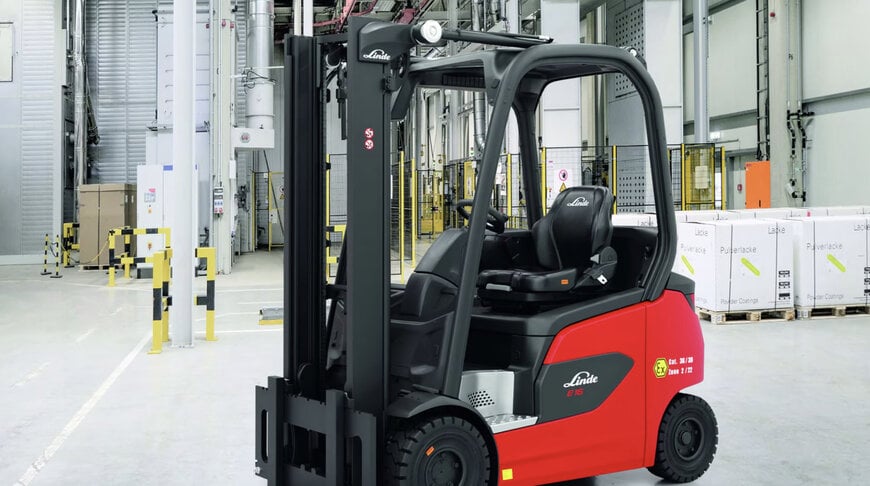
Linde Material Handling has updated its portfolio of explosion-protected electric forklifts with new models designed for highly flammable manufacturing operations. These three- and four-wheeled counterbalanced trucks are engineered to maintain the performance of standard models while meeting strict ATEX zone certifications.
Explosion-Protected Material Handling for Hazardous Production
The European Chips Act has driven an expansion of semiconductor factories across Europe, increasing the demand for material handling equipment capable of operating safely around hazardous and flammable substances. Additionally, the growth in battery manufacturing and electronic waste recycling requires ATEX-certified operational zones. To address these requirements, Linde Material Handling (MH) has released the Linde E14 to E20 EX and Linde E16 to E20 P EX models. The series consists of 14 models offering varying chassis sizes and load capacities of up to two tons. The compact three-wheeled variants are designed for confined warehouse and production environments, while the four-wheeled units provide stability on uneven surfaces.
Original Equipment Manufacturing and Chassis Integration
For explosion-protected vehicles, integrating safety components without compromising ergonomics is a key engineering challenge. Because the conversion process takes place near the series production facility in Aschaffenburg, Linde MH incorporates flame-proof housings directly into the vehicle architecture. The housings containing electronic components are installed to avoid altering the external contours of the forklift, ensuring that operator visibility and legroom are not obstructed by external enclosures mounted on the rear or in the footwell. Elke Karnarski, Product Manager EX-Proof Trucks and Safety Solutions at Linde MH, stated that the company orders prototypes directly from the pilot series and accesses all development documents to quickly present models for demanding zone 1/21 applications. Karnarski noted that operators utilize the same interface and comfort features found in series-production vehicles.
Thermal Management for Zone 1/21 Environments
In production areas where hazardous substances are processed, there is a higher probability of explosive atmospheres. To maintain motor performance while adhering to safety temperature limits, Linde MH engineers integrated specific thermal controls. For zone 1/21 models, the company installed motors with special windings and higher insulation classes to meet ATEX safety requirements. Karnarski explained that sensors are integrated directly into the motor winding to continuously measure the temperature exactly where it is generated.
Driver Assistance and Object Detection Systems
The explosion-protected models can be equipped with either a Reverse Assist Camera or a Reverse Assist Radar to enhance operational safety. The camera utilizes artificial intelligence to distinguish between pedestrians and objects. The system detects the distance to a pedestrian, initiates braking, and provides an audible warning to the driver. Alternatively, the Reverse Assist Radar reduces speed or brings the forklift to a complete stop by calculating the required braking distance based on the vehicle speed, fork load, steering angle, and the distance to the object.
Furthermore, the Linde Safety Guard system automatically reduces the forklift's speed when it enters a defined ATEX zone and implements mutual warning signals for intersecting forklifts in zone 2/22. Visual safety is supported by ATEX-certified lighting solutions, including VertiLights, LED stripes, and red warning lines projected alongside the vehicle.
Environmental Control and Cabin Heating
To support operator visibility and environmental control when handling hazardous materials, the new explosion-protected electric forklifts include a specialized blower heating system. The system utilizes eight nozzles directed at the windshield, interior, and footwell, and is fully certified for zones 1/21 and 2/22. A preheating function ensures the cabin reaches the optimal temperature before operation begins.
Additional Context:
This section details technical specifications and competitive benchmarking not included in the original product announcement
In the explosion-protected material handling market, manufacturers provide ATEX compliant equipment through two primary pathways: third-party conversions or direct original equipment manufacturer (OEM) integration. Competitors such as Jungheinrich and Toyota typically collaborate with specialized engineering firms like Pyroban or Miretti to retrofit standard forklift models for ATEX Zone 1/21 and 2/22 compliance. These retrofits often involve adding external explosion-proof enclosures for electronic components, which can alter the vehicle's original dimensions or ergonomics. In contrast, Linde Material Handling utilizes an OEM integration strategy, embedding flame-proof housings and thermal sensors directly during the initial manufacturing process. This approach aligns with offerings from specialized ATEX manufacturers like Stöcklin, ensuring that the physical footprint, visibility, and operator legroom remain identical to standard non-hazardous vehicle counterparts.
Edited by Natania Lyngdoh, Induportals editor, assisted by AI.
www.linde-mh.com
