
www.intralogisticsmag.com
21
'26
Written on Modified on
Kenco Innovation Lab Showcases GreyOrange’s AI-Powered Warehouse Orchestration
In the lab, GreyOrange’s GreyMatter software manages a single order’s journey across technology from multiple vendors and the workforce, all on one floor.
www.greyorange.com
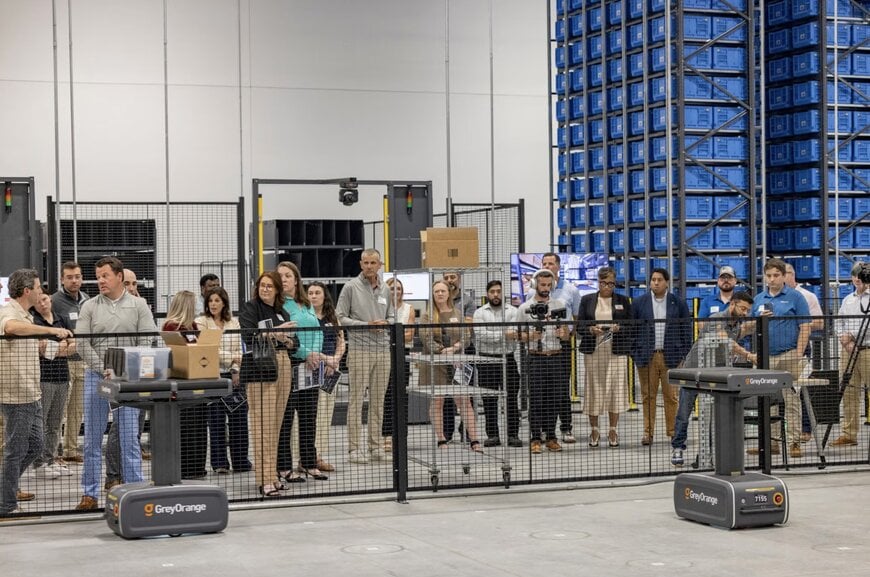
GreyOrange has announced the deployment of its warehouse orchestration technology within the newly expanded Kenco Innovation Lab. Developed by third-party logistics (3PL) provider Kenco, the 30,000-square-foot testing facility provides supply chain operators, retailers, and distributors with a physical proving ground to evaluate advanced automation hardware and software systems under operational conditions prior to capital deployment. First established in 2015 and expanded in 2019, Kenco’s updated lab represents a threefold expansion in footprint over the original installation.
Warehouse Orchestration and Logistics Metrics
Kenco initially partnered with GreyOrange in 2024, deploying the GreyMatter warehouse orchestration platform across a network of regional distribution facilities to synchronize automated mobile robots with floor personnel. Commercial metrics achieved at an active customer distribution facility using this orchestration architecture include:
- A 20% reduction in outbound transportation expenses.
- A 30% reduction in total pallets required per fulfilled order.
- A twofold increase in hourly case-picking throughput.
Following these production deployments, GreyOrange named Kenco as the recipient of its inaugural Elite Partner of the Year award.
Multi-Agent Coordination and Lab Demonstration Scope
Demonstrations inside the testing facility highlight GreyMatter as the sole platform in the facility executing vendor-agnostic multi-agent orchestration. The software directs physical workflows across three operational domains: goods-to-person picking stations for omnichannel e-commerce fulfillment, automated outbound parcel and pallet sortation, and point-to-point case picking routines. System logic coordinates disparate material handling equipment from multiple original equipment manufacturers alongside warehouse associates on an active distribution floor from initial pick generation to outbound dispatch.
Additional Context
This section details technical specifications not included in the original news release.
Multi-agent warehouse orchestration engines deploy real-time path planning and dynamic task allocation algorithms—such as Conflict-Based Search (CBS) and time-space network routing—to coordinate heterogeneous fleets of autonomous mobile robots (AMRs), automated guided vehicles (AGVs), and automated storage and retrieval systems (ASRS). Standardized interoperability across disparate robotic vendors relies on communication frameworks such as VDA 5050 or open REST/WebSocket APIs, which separate high-level fleet orchestration from low-level robot kinematic control loops. System architectures interface directly with Warehouse Management Systems (WMS) and Enterprise Resource Planning (ERP) databases via publish-subscribe message brokers like Apache Kafka or MQTT. By continuously evaluating real-time travel times, battery state-of-charge (SoC), order drop cutoffs, and station congestion, the orchestration solver recalculates work queues dynamically to minimize empty travel miles and eliminate pick-station queuing bottlenecks.
Edited by Romila DSilva, Induportals Editor, with AI assistance.
Multi-Agent Coordination and Lab Demonstration Scope
Demonstrations inside the testing facility highlight GreyMatter as the sole platform in the facility executing vendor-agnostic multi-agent orchestration. The software directs physical workflows across three operational domains: goods-to-person picking stations for omnichannel e-commerce fulfillment, automated outbound parcel and pallet sortation, and point-to-point case picking routines. System logic coordinates disparate material handling equipment from multiple original equipment manufacturers alongside warehouse associates on an active distribution floor from initial pick generation to outbound dispatch.
Additional Context
This section details technical specifications not included in the original news release.
Multi-agent warehouse orchestration engines deploy real-time path planning and dynamic task allocation algorithms—such as Conflict-Based Search (CBS) and time-space network routing—to coordinate heterogeneous fleets of autonomous mobile robots (AMRs), automated guided vehicles (AGVs), and automated storage and retrieval systems (ASRS). Standardized interoperability across disparate robotic vendors relies on communication frameworks such as VDA 5050 or open REST/WebSocket APIs, which separate high-level fleet orchestration from low-level robot kinematic control loops. System architectures interface directly with Warehouse Management Systems (WMS) and Enterprise Resource Planning (ERP) databases via publish-subscribe message brokers like Apache Kafka or MQTT. By continuously evaluating real-time travel times, battery state-of-charge (SoC), order drop cutoffs, and station congestion, the orchestration solver recalculates work queues dynamically to minimize empty travel miles and eliminate pick-station queuing bottlenecks.
Edited by Romila DSilva, Induportals Editor, with AI assistance.
