
www.intralogisticsmag.com
22
'26
Written on Modified on
VisionNav expands autonomous warehouse fleets with smarter orchestration technology
RCS2.0 coordinates diverse autonomous vehicles, manages traffic and exceptions, integrates systems, and optimizes material flow across increasingly complex warehouses.
www.visionnav.com
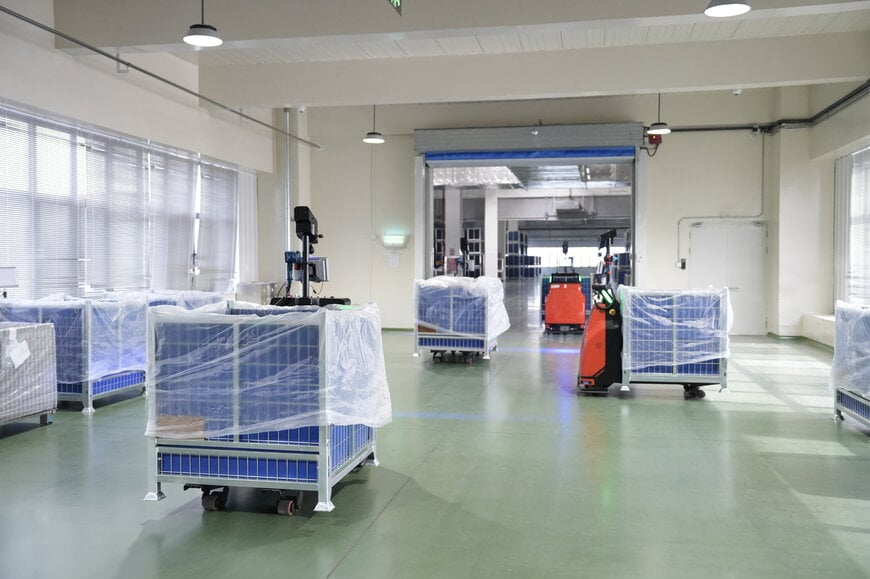
VisionNav Robotics has outlined an operational strategy centered on its RCS2.0 robot control system and BrightEye platform to orchestrate heterogeneous autonomous mobile fleets across complex intra-logistics workflows. The software framework addresses throughput bottlenecks, dynamic traffic routing, and multi-machine coordination across receiving, manufacturing, high-bay storage, and outbound distribution zones.
Dynamic Task Allocation and Heterogeneous Fleet Coordination
Scaling warehouse automation past isolated transport tasks shifts operational constraints from individual vehicle kinematics to system-wide material flow. Maximizing vehicle velocity or individual machine utilization can increase traffic density, compound queue delays, and generate bottlenecks at shared physical nodes. Centralized fleet orchestration resolves this constraint by dynamically assigning tasks according to machine classification, real-time spatial proximity, operational battery state, localized traffic density, and downstream workstation capacity.
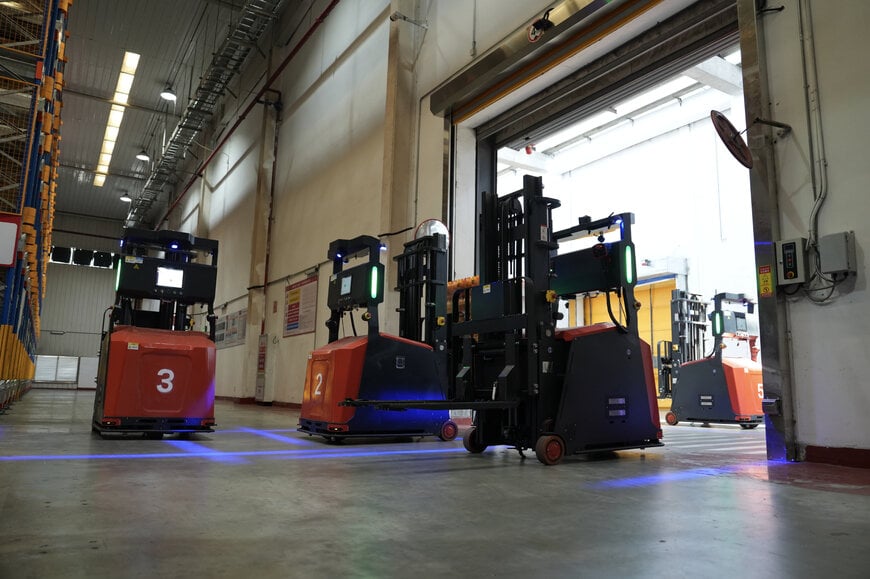
Industrial facilities frequently combine disparate kinematic platforms to handle varied payload profiles and storage heights. In a deployment across a 5,000-square-meter beverage manufacturing facility, the RCS2.0 software platform coordinated seven VNP15 counterbalance automated guided vehicles with three VNR16 reach trucks. The centralized scheduling layer routed payloads between multiple production lines, pallet staging positions, packaging material zones, racking arrays, and outbound docks, preventing localized routing deadlocks across functional zones.
Traffic Management, Perception Systems, and Exception Handling
System-level path planning replaces local shortest-path navigation algorithms to avoid shared-route congestion. The orchestration platform dynamically assigns alternative paths, introduces sequenced holds, and coordinates right-of-way based on mission urgency. Allowing individual machines to yield preserves broader aisle throughput, optimizing fleet-wide transport velocity over single-machine transit times.
At the equipment layer, automated guided vehicles combine light detection and ranging sensors with visual perception systems to perform dynamic load-position correction and automated pickup retries on irregular or shifted pallets. When unresolvable mechanical or physical obstructions emerge, such as blocked aisles or unavailable storage buffers, the RCS2.0 software isolates the disturbance. The centralized controller reassigns pending missions and reroutes nearby traffic, preventing localized interruptions from propagating across the fleet.
Enterprise Systems Integration and Facility Simulation
The orchestration system connects physical transport mechanisms to core enterprise resource platforms, integrating bidirectional communication with warehouse management systems, warehouse execution systems, and programmable logic controllers controlling doors, elevators, and conveyors. These external data streams supply execution parameters for production line replenishment and pallet dispatch.
Operationally, the platform records functional metrics, including transit durations, idle waiting intervals, charging frequencies, and spatial congestion points. The BrightEye optical monitoring module adds supervisory tracking of inventory positioning and vehicle movement. To determine fleet configurations prior to physical commissioning, system designers execute simulation modeling to assess aisle geometries, intersection capacities, battery consumption, and projected throughput rates.
Additional Context:
This section details technical specifications and competitive benchmarking not included in the original product announcement
Centralized fleet control within industrial intra-logistics relies on standard communication interfaces to bridge automated guided vehicles (AGVs), autonomous mobile robots (AMRs), and enterprise software. A widely adopted standard in multi-vendor robotic orchestration is VDA 5050, developed by the German Association of the Automotive Industry (VDA) and the VDMA Materials Handling and Intralogistics Association. VDA 5050 defines an open, platform-agnostic communication protocol utilizing the Message Queuing Telemetry Transport (MQTT) messaging format with JavaScript Object Notation (JSON) payloads to transmit order, status, and dynamic map layers between master controllers and mobile robots.
In commercial fleet management, comparable enterprise orchestration platforms include Blue Yonder Robotics Hub, Swisslog SynQ, and enterprise vehicle fleet systems from providers such as KION Group and Toyota Material Handling.
Unlike single-chassis supervisory systems that manage homogenous kinematic classes (such as standard low-profile AMRs or traditional tuggers), systems managing complex industrial mobile assets must coordinate multi-degree-of-freedom machines. Counterbalance autonomous forklifts and reach trucks—such as the VisionNav VNR16, which reaches lift elevations up to 11 meters with 1.6-metric-ton load capacities—demand complex 3D kinematic clearance models, vertical mast cycle time integration, and dynamic turning radius management, differentiating them from two-dimensional grid-based sorting algorithms used in basic autonomous mobile robot fleets.
Edited by Natania Lyngdoh, Induportals editor, assisted by AI.
www.visionnav.com
