
www.intralogisticsmag.com
23
'26
Written on Modified on
Elster Automates Production Supply with Jungheinrich Autonomous Mobile Robot
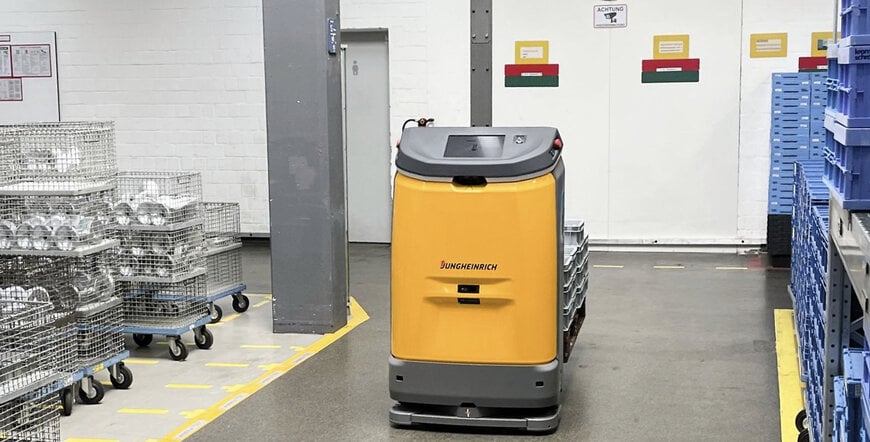
EAE 212a serves twelve stations across 210 metres, transporting pallets autonomously without artificial landmarks and enabling scalable expansion as requirements grow.
www.jungheinrich.co.uk
Application area: Intralogistics and automated material transport
Industry sector: Industrial gas measurement and control equipment manufacturing
Elster GmbH, an operating unit of Honeywell that manufactures safety, measurement, and control equipment for gas networks, launched an intralogistics modernization initiative at its production plant in Lotte near Osnabrück. The company introduced an autonomous mobile robot to handle floor-level pallet deliveries directly to manufacturing areas, initiating a pilot project designed to evaluate real-world efficiency gains and establish a scalable framework for future transport automation.
Internal Transport Bottlenecks and Operational Demands
Material distribution between storage buffers and production cells at the Lotte plant relied on manual transport methods. Operators had to dedicate significant working hours to routine handling runs, leaving internal logistics vulnerable to staff availability and shifting production cycles. In a multi-shift manufacturing environment, these repetitive transport tasks tied up qualified assembly workers in non-value-adding transit. Management required a system that could eliminate recurring manual runs, maintain steady material feeds to assembly lines, and improve floor safety.
Target Goals for In-Plant Material Handling
The facility targeted specific operational benchmarks to improve productivity and workflow continuity:
Industry sector: Industrial gas measurement and control equipment manufacturing
Elster GmbH, an operating unit of Honeywell that manufactures safety, measurement, and control equipment for gas networks, launched an intralogistics modernization initiative at its production plant in Lotte near Osnabrück. The company introduced an autonomous mobile robot to handle floor-level pallet deliveries directly to manufacturing areas, initiating a pilot project designed to evaluate real-world efficiency gains and establish a scalable framework for future transport automation.
Internal Transport Bottlenecks and Operational Demands
Material distribution between storage buffers and production cells at the Lotte plant relied on manual transport methods. Operators had to dedicate significant working hours to routine handling runs, leaving internal logistics vulnerable to staff availability and shifting production cycles. In a multi-shift manufacturing environment, these repetitive transport tasks tied up qualified assembly workers in non-value-adding transit. Management required a system that could eliminate recurring manual runs, maintain steady material feeds to assembly lines, and improve floor safety.
Target Goals for In-Plant Material Handling
The facility targeted specific operational benchmarks to improve productivity and workflow continuity:
- Eliminate recurring manual pallet runs to free personnel for skilled assembly and value-adding tasks.
- Maintain reliable production line feeding across multi-shift schedules without transport interruptions.
- Integrate transport automation into active production zones without structural plant renovations or physical infrastructure modifications.
- Establish a modular system that allows sequential expansion as internal throughput requirements increase.
Technical Features of the Autonomous Solution
To meet these operational criteria, Elster GmbH introduced a low-lift autonomous mobile robot capable of handling standardized EPAL 1 euro pallets with loads up to 1,200 kilograms. The vehicle serves twelve designated drop-off stations along a 210-metre transit loop within the plant. Power management relies on an integrated lithium-ion battery supported by an automatic opportunity-charging system, which charges the unit during idle intervals to sustain continuous multi-shift availability.
Vehicle routing and control are managed by a centralized mobile robot controller paired with localized I/O peripheral interfaces. The vehicle utilizes contour-based navigation that operates without reflective targets, floor magnets, or other artificial landmarks. On-board safety sensors detect fixed and moving obstacles, allowing the unit to navigate around obstructions autonomously and operate alongside pedestrian workers and standard equipment.
Deployment and Systems Integration
The implementation required zero modifications to the warehouse floor or building infrastructure, accommodating variable floor surfaces throughout the 210-metre transit path. System provider Jungheinrich supplied the vehicle hardware, control software, and peripheral communication components while working closely with plant engineers to configure delivery schedules and station coordinates.
Operational Results and Scalability
The implementation successfully transferred repetitive transit runs from floor staff to automated transport. The single unit maintains steady replenishment across twelve production points while operating safely in mixed-traffic zones. Personnel previously assigned to manual transport are now deployed in skilled assembly operations, reducing labor dependencies and standardizing delivery cycle times. The modular system architecture enables Elster GmbH to scale fleet capacity by adding matching units to the existing control infrastructure as operational volumes grow.
Edited by Natania Lyngdoh, Induportals Editor, with AI assistance.
www.jungheinrich.com
To meet these operational criteria, Elster GmbH introduced a low-lift autonomous mobile robot capable of handling standardized EPAL 1 euro pallets with loads up to 1,200 kilograms. The vehicle serves twelve designated drop-off stations along a 210-metre transit loop within the plant. Power management relies on an integrated lithium-ion battery supported by an automatic opportunity-charging system, which charges the unit during idle intervals to sustain continuous multi-shift availability.
Vehicle routing and control are managed by a centralized mobile robot controller paired with localized I/O peripheral interfaces. The vehicle utilizes contour-based navigation that operates without reflective targets, floor magnets, or other artificial landmarks. On-board safety sensors detect fixed and moving obstacles, allowing the unit to navigate around obstructions autonomously and operate alongside pedestrian workers and standard equipment.
Deployment and Systems Integration
The implementation required zero modifications to the warehouse floor or building infrastructure, accommodating variable floor surfaces throughout the 210-metre transit path. System provider Jungheinrich supplied the vehicle hardware, control software, and peripheral communication components while working closely with plant engineers to configure delivery schedules and station coordinates.
Operational Results and Scalability
The implementation successfully transferred repetitive transit runs from floor staff to automated transport. The single unit maintains steady replenishment across twelve production points while operating safely in mixed-traffic zones. Personnel previously assigned to manual transport are now deployed in skilled assembly operations, reducing labor dependencies and standardizing delivery cycle times. The modular system architecture enables Elster GmbH to scale fleet capacity by adding matching units to the existing control infrastructure as operational volumes grow.
Edited by Natania Lyngdoh, Induportals Editor, with AI assistance.
www.jungheinrich.com
