
www.intralogisticsmag.com
25
'26
Written on Modified on
The Intelligent Warehouse: How AI is Redefining Intralogistics
How artificial intelligence is transforming the warehouse from an automated facility into an intelligent, decision-making system.
induportals-media-publishing.com
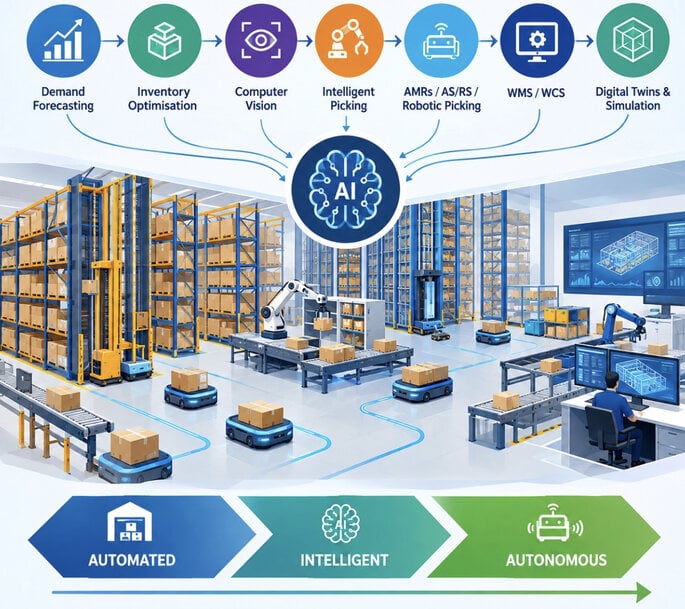
AI-based systems can analyse much larger and more diverse datasets. AI generated image.
The warehouse is undergoing a fundamental transformation. For decades, warehouse automation focused primarily on mechanising repetitive tasks – moving, storing, sorting and retrieving goods faster and more accurately. Today, artificial intelligence (AI) is adding a new layer of intelligence to these physical systems.
The emerging intelligent warehouse is not simply a warehouse equipped with robots. It is an environment where data, AI, software, sensors, computer vision and automation work together to continuously make and execute decisions.
The central shift is from asking ‘how can a warehouse automate a task?’ to asking ‘what is the best decision to make, and how can the system execute it automatically?’
From forecasting demand to optimising inventory
One of the earliest and most valuable applications of AI in warehousing lies upstream of physical automation: demand forecasting and inventory optimisation.
Traditional forecasting often relies on historical sales patterns, seasonal trends and manually defined rules. AI-based systems can analyse much larger and more diverse datasets, including order histories, product velocity, promotions, market conditions, lead times and changing customer behaviour.
This allows warehouse operators to anticipate demand more dynamically and determine where inventory should be positioned, how much stock should be maintained and when replenishment should occur. The result is a move from reactive inventory management towards predictive inventory management. Instead of responding to stockouts, excess inventory or sudden order peaks, AI can identify emerging patterns and recommend – or increasingly trigger – corrective actions.
This has direct implications for warehouse capacity. Better inventory decisions can reduce unnecessary stock, improve space utilisation and ensure that fast-moving products are positioned closer to picking and dispatch operations.
Computer vision makes the warehouse more perceptive
AI becomes even more powerful when combined with computer vision. Cameras and vision systems can identify products, read labels, detect damage, verify quantities and assess the position and orientation of objects. This provides machines with a degree of perception that was previously difficult to achieve.
Computer vision is particularly important for intelligent picking. Warehouses increasingly handle thousands of SKUs with different dimensions, packaging formats and physical characteristics. AI-powered vision can help robotic systems recognise an object, determine how it should be grasped and select an appropriate picking strategy.
This is helping move robotic picking beyond highly structured environments towards more variable operations where product mix and presentation can change continuously.
AMRs, AS/RS and the rise of intelligent execution
The physical layer of the intelligent warehouse is being reshaped by Autonomous Mobile Robots (AMRs), Automated Storage and Retrieval Systems (AS/RS), robotic picking systems and automated material-handling equipment.
AMRs can dynamically transport goods between receiving, storage, picking, replenishment and dispatch areas. Unlike fixed conveyors, they can provide greater flexibility in warehouse layouts and can be deployed incrementally.
AS/RS technologies, meanwhile, provide high-density storage and automated retrieval. When connected to intelligent software, storage locations need no longer be treated as static assignments. Inventory can be dynamically positioned according to factors such as demand, order priority, product characteristics and warehouse congestion.
Robotic picking adds another dimension by combining AI perception, motion planning and machine learning with robotic manipulation.
The important development is therefore not any single robot. It is the ability of AI to coordinate multiple forms of automation according to changing operational conditions.
WMS and WCS become the intelligence layer
This is where Warehouse Management Systems (WMS) and Warehouse Control Systems (WCS) become critical.
The WMS traditionally manages inventory, orders, locations, replenishment and broader warehouse processes. The WCS operates closer to the equipment, coordinating conveyors, AS/RS, sorters, robots and other material-handling systems.
AI is increasingly connecting these layers to create more responsive decision-making. Instead of simply executing predefined rules, intelligent software can analyse operational data and adjust workflows according to current conditions.
For example, an AI-enabled system could identify a developing bottleneck, redirect inventory or transport tasks, change picking priorities or optimise robot movements before the bottleneck becomes a major disruption.
Körber, for example, describes its WCS as a vendor-agnostic layer connecting WMS and material-handling equipment, with capabilities including dynamic routing, optimisation and offline emulation. The company has also introduced AI-based tools that allow operators to query warehouse data using natural language.
Digital twins: Simulating before executing
The next step is to make warehouse intelligence predictive as well as responsive.
Digital twins and simulation allow operators to create virtual representations of warehouse layouts, equipment and processes. Different scenarios can then be tested before changes are implemented in the physical facility.
What happens if order volumes increase by 30%? Where will congestion occur if another AMR fleet is introduced? Would a different storage strategy improve throughput? How many robots are required during peak periods?
AI-enhanced simulation can help answer such questions before capital is committed.
Körber, for instance, announced a collaboration with NVIDIA in 2026 focused on using AI and simulation technologies to create physics-accurate digital twins of warehouses and logistics facilities.
From automated to autonomous warehouses
The long-term direction is therefore autonomy. An automated warehouse performs tasks according to programmed rules. An autonomous warehouse goes further: it can sense its environment, interpret data, make decisions, adapt to changing circumstances and continuously optimise its operations with limited human intervention.
The transition will not happen overnight. Human oversight will remain important, particularly for exception handling, safety, strategic decisions and unusual operating conditions. But the balance is changing.
The intelligent warehouse is increasingly becoming a closed-loop system:
Sense → Analyse → Decide → Execute → Learn → Optimise.
That loop is the real significance of AI in intralogistics.
Competitive landscape: three approaches to intelligent warehousing
The market includes a wide range of technology providers, but Dematic, Körber and Geekplus illustrate three distinctive approaches.
Dematic brings extensive experience in integrated supply-chain automation, combining physical automation with software and operational expertise. Its positioning emphasises intelligent supply-chain solutions, flexible and scalable operations, and software-driven decision-making across complex warehouse environments.
Körber has a broad end-to-end intralogistics portfolio spanning AS/RS, AMRs, material handling, picking, robotics, WMS/WCS and digital solutions. Its strength lies in integrating multiple technologies into customised warehouse architectures rather than treating individual automation systems in isolation.
Geekplus has built its proposition strongly around robotics, particularly goods-to-person, tote-to-person and pallet-to-person systems, mobile robots and robotic picking. Its unified architecture connects its robotic solutions with warehouse management and data-driven optimisation.
These approaches are not mutually exclusive. As the market develops, the distinction between warehouse robotics, automation and software is becoming increasingly blurred.
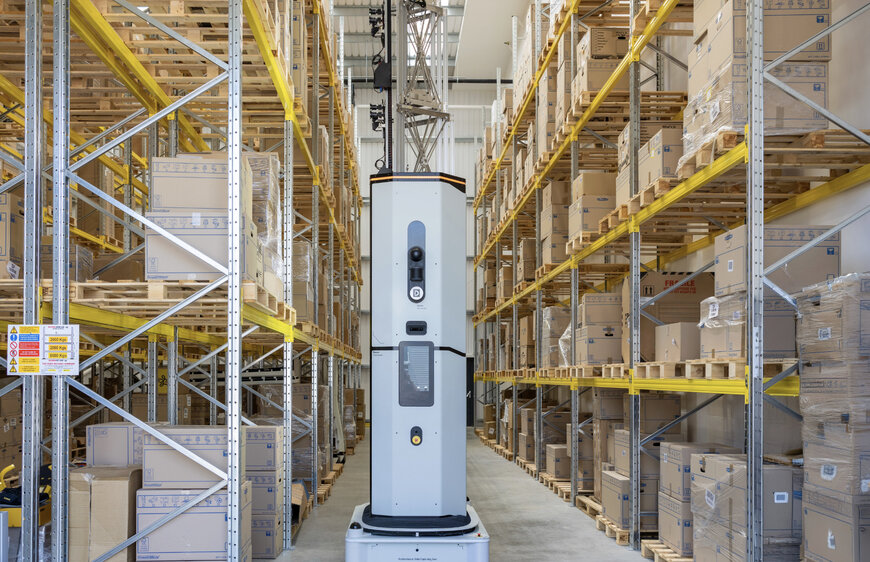
Körber’s adaptable supply chain execution solutions integrated with Dexory’s advanced visibility platform. Image source: Business Wire
The warehouse becomes a decision engine
The intelligent warehouse represents a fundamental change in intralogistics. AI is moving beyond isolated applications such as forecasting or robotic picking and becoming an intelligence layer connecting inventory, people, machines, software and physical flows.
The competitive advantage will increasingly come not simply from having more automation, but from making better decisions and executing those decisions faster.
The warehouse of the future will therefore be less about machines working independently and more about interconnected systems continuously sensing demand, analysing conditions, allocating resources and adapting execution.
The journey from automated to autonomous warehousing has begun – and AI is becoming the technology that connects the two.
Article contributed by Milton D’Silva, a freelance technical writer, and former editor of Industrial Products Finder, India.
www.intralogisticsmag.com
The warehouse is undergoing a fundamental transformation. For decades, warehouse automation focused primarily on mechanising repetitive tasks – moving, storing, sorting and retrieving goods faster and more accurately. Today, artificial intelligence (AI) is adding a new layer of intelligence to these physical systems.
The emerging intelligent warehouse is not simply a warehouse equipped with robots. It is an environment where data, AI, software, sensors, computer vision and automation work together to continuously make and execute decisions.
The central shift is from asking ‘how can a warehouse automate a task?’ to asking ‘what is the best decision to make, and how can the system execute it automatically?’
From forecasting demand to optimising inventory
One of the earliest and most valuable applications of AI in warehousing lies upstream of physical automation: demand forecasting and inventory optimisation.
Traditional forecasting often relies on historical sales patterns, seasonal trends and manually defined rules. AI-based systems can analyse much larger and more diverse datasets, including order histories, product velocity, promotions, market conditions, lead times and changing customer behaviour.
This allows warehouse operators to anticipate demand more dynamically and determine where inventory should be positioned, how much stock should be maintained and when replenishment should occur. The result is a move from reactive inventory management towards predictive inventory management. Instead of responding to stockouts, excess inventory or sudden order peaks, AI can identify emerging patterns and recommend – or increasingly trigger – corrective actions.
This has direct implications for warehouse capacity. Better inventory decisions can reduce unnecessary stock, improve space utilisation and ensure that fast-moving products are positioned closer to picking and dispatch operations.
Computer vision makes the warehouse more perceptive
AI becomes even more powerful when combined with computer vision. Cameras and vision systems can identify products, read labels, detect damage, verify quantities and assess the position and orientation of objects. This provides machines with a degree of perception that was previously difficult to achieve.
Computer vision is particularly important for intelligent picking. Warehouses increasingly handle thousands of SKUs with different dimensions, packaging formats and physical characteristics. AI-powered vision can help robotic systems recognise an object, determine how it should be grasped and select an appropriate picking strategy.
This is helping move robotic picking beyond highly structured environments towards more variable operations where product mix and presentation can change continuously.
AMRs, AS/RS and the rise of intelligent execution
The physical layer of the intelligent warehouse is being reshaped by Autonomous Mobile Robots (AMRs), Automated Storage and Retrieval Systems (AS/RS), robotic picking systems and automated material-handling equipment.
AMRs can dynamically transport goods between receiving, storage, picking, replenishment and dispatch areas. Unlike fixed conveyors, they can provide greater flexibility in warehouse layouts and can be deployed incrementally.
AS/RS technologies, meanwhile, provide high-density storage and automated retrieval. When connected to intelligent software, storage locations need no longer be treated as static assignments. Inventory can be dynamically positioned according to factors such as demand, order priority, product characteristics and warehouse congestion.
Robotic picking adds another dimension by combining AI perception, motion planning and machine learning with robotic manipulation.
The important development is therefore not any single robot. It is the ability of AI to coordinate multiple forms of automation according to changing operational conditions.
WMS and WCS become the intelligence layer
This is where Warehouse Management Systems (WMS) and Warehouse Control Systems (WCS) become critical.
The WMS traditionally manages inventory, orders, locations, replenishment and broader warehouse processes. The WCS operates closer to the equipment, coordinating conveyors, AS/RS, sorters, robots and other material-handling systems.
AI is increasingly connecting these layers to create more responsive decision-making. Instead of simply executing predefined rules, intelligent software can analyse operational data and adjust workflows according to current conditions.
For example, an AI-enabled system could identify a developing bottleneck, redirect inventory or transport tasks, change picking priorities or optimise robot movements before the bottleneck becomes a major disruption.
Körber, for example, describes its WCS as a vendor-agnostic layer connecting WMS and material-handling equipment, with capabilities including dynamic routing, optimisation and offline emulation. The company has also introduced AI-based tools that allow operators to query warehouse data using natural language.
Digital twins: Simulating before executing
The next step is to make warehouse intelligence predictive as well as responsive.
Digital twins and simulation allow operators to create virtual representations of warehouse layouts, equipment and processes. Different scenarios can then be tested before changes are implemented in the physical facility.
What happens if order volumes increase by 30%? Where will congestion occur if another AMR fleet is introduced? Would a different storage strategy improve throughput? How many robots are required during peak periods?
AI-enhanced simulation can help answer such questions before capital is committed.
Körber, for instance, announced a collaboration with NVIDIA in 2026 focused on using AI and simulation technologies to create physics-accurate digital twins of warehouses and logistics facilities.
From automated to autonomous warehouses
The long-term direction is therefore autonomy. An automated warehouse performs tasks according to programmed rules. An autonomous warehouse goes further: it can sense its environment, interpret data, make decisions, adapt to changing circumstances and continuously optimise its operations with limited human intervention.
The transition will not happen overnight. Human oversight will remain important, particularly for exception handling, safety, strategic decisions and unusual operating conditions. But the balance is changing.
The intelligent warehouse is increasingly becoming a closed-loop system:
Sense → Analyse → Decide → Execute → Learn → Optimise.
That loop is the real significance of AI in intralogistics.
Competitive landscape: three approaches to intelligent warehousing
The market includes a wide range of technology providers, but Dematic, Körber and Geekplus illustrate three distinctive approaches.
Dematic brings extensive experience in integrated supply-chain automation, combining physical automation with software and operational expertise. Its positioning emphasises intelligent supply-chain solutions, flexible and scalable operations, and software-driven decision-making across complex warehouse environments.
Körber has a broad end-to-end intralogistics portfolio spanning AS/RS, AMRs, material handling, picking, robotics, WMS/WCS and digital solutions. Its strength lies in integrating multiple technologies into customised warehouse architectures rather than treating individual automation systems in isolation.
Geekplus has built its proposition strongly around robotics, particularly goods-to-person, tote-to-person and pallet-to-person systems, mobile robots and robotic picking. Its unified architecture connects its robotic solutions with warehouse management and data-driven optimisation.
These approaches are not mutually exclusive. As the market develops, the distinction between warehouse robotics, automation and software is becoming increasingly blurred.
Körber’s adaptable supply chain execution solutions integrated with Dexory’s advanced visibility platform. Image source: Business Wire
The warehouse becomes a decision engine
The intelligent warehouse represents a fundamental change in intralogistics. AI is moving beyond isolated applications such as forecasting or robotic picking and becoming an intelligence layer connecting inventory, people, machines, software and physical flows.
The competitive advantage will increasingly come not simply from having more automation, but from making better decisions and executing those decisions faster.
The warehouse of the future will therefore be less about machines working independently and more about interconnected systems continuously sensing demand, analysing conditions, allocating resources and adapting execution.
The journey from automated to autonomous warehousing has begun – and AI is becoming the technology that connects the two.
Article contributed by Milton D’Silva, a freelance technical writer, and former editor of Industrial Products Finder, India.
www.intralogisticsmag.com
