
www.intralogisticsmag.com
28
'26
Written on Modified on
Barcode Scanning Fits Beneath Narrow Conveyor Gaps
Cognex’s line-scan system combines 5 mm gap clearance with embedded processing for automated package identification and sortation.
www.cognex.com
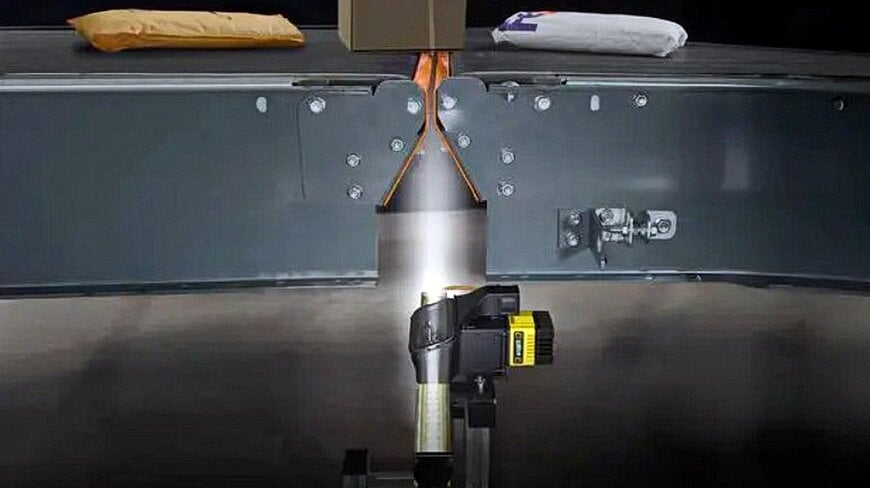
Cognex Corporation deployed an industrial-grade bottom-side barcode reading solution, the SLX-3804L, engineered for integration into high-throughput logistics hubs, distribution centers, and baggage-handling facilities. The system operates beneath existing conveyor lines to capture code data across outbound shipping lines, six-sided scanning tunnels, and induction stations.
Line-Scan Architecture and Conveyor Integration
Bottom-side package scanning presents mechanical constraints in automated sorting lines, where conveyor drop gaps typically create focal length issues and structural interference. The SLX-3804L addresses these physical constraints by operating across conveyor gaps as narrow as 5 mm. Its low-profile chassis installs directly beneath conveyor transfers without requiring line re-engineering, structural elevation, or prolonged mechanical downtime. The system maintains a documented 99.9% read rate on standard linear and matrix symbologies, minimizing package re-circulation and manual intervention in high-volume transport systems.
Embedded Edge Processing and System Deployment
Traditional line-scan deployments often rely on external industrial personal computers (IPCs) to process raw sensor feeds, which introduces points of failure and software maintenance complexity. The SLX-3804L utilizes integrated processing units, running a web-based setup utility with guided configuration tools to eliminate dedicated external IPC requirements. Monty McVaugh, Head of Product at OPEX Corporation, noted that retrofitting the solution into automated sortation systems streamlined the network architecture and reduced local network attack surfaces by removing standalone host computers. Ben Carey, Director of Product Management for Logistics at Cognex, stated that coupling line-scan reliability with a standardized setup workflow addresses the historical barrier of requiring specialized optical calibration engineers on site.
Additional Context
This section details technical specifications and competitive benchmarking not included in the original product announcement.
Industrial bottom-side barcode scanning has historically relied on two competing architectures: multi-camera area-scan mirrors and high-speed line-scan linear sensors. Area-scan systems, such as SICK ICR890 or Datalogic AV900 configurations, deploy matrix image sensors with mirror deflection units to achieve wide fields of view under conveyors. While area-scan systems handle broader conveyor gaps, they typically require larger enclosure envelopes and optical clearance. In contrast, line-scan solutions like the Cognex SLX-3804L read packages line-by-line through tight conveyor transfers (5 mm gap clearance), maintaining image sharpness at linear belt speeds exceeding 2.5 to 3.0 m/s without the perspective distortion common to wide-angle matrix optics. Standard line-scan competitor platforms commonly demand separate rack-mounted vision controllers running GigE Vision interfaces, whereas the SLX-3804L embeds image acquisition, barcode decoding algorithms, and secure industrial Ethernet protocols directly on the sensor head.
Edited by Evgeny Churilov, Induportals Media - Adapted by AI.
www.cognex.com
