
www.intralogisticsmag.com
30
'26
Written on Modified on
Zebra Technologies at VISION 2026
From 6 to 8 October in Stuttgart, Germany, Zebra Technologies presents integrated AI and 3D machine vision solutions for logistics.
www.zebra.com
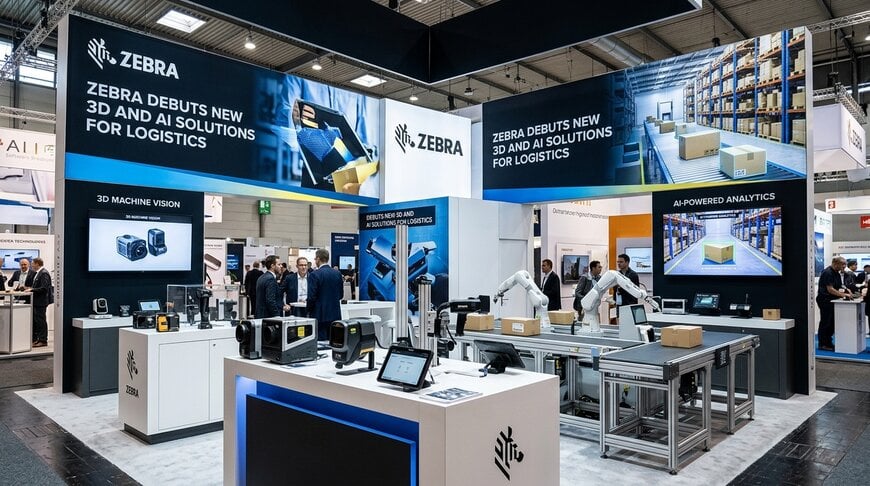
Zebra Technologies Corporation presents its expanded portfolio of artificial intelligence and 3D machine vision systems designed to automate visual inspection and material handling in logistics and manufacturing environments.
Core Technology and System Architecture
The platform architecture integrates dedicated edge processing, high-bandwidth sensor acquisition, and specialized software runtimes. The NS42 smart vision sensor integrates an on-device neural processing unit to execute deep learning classification, segmentation, anomaly detection, and optical character recognition directly at the sensor level. Text recognition relies on pre-trained neural models capable of segmenting low-contrast characters, embossed surfaces, and laser-marked data codes without external processing host dependence. Anomaly detection operates via statistical deviation heatmaps compared against baseline references, bypassing traditional rule-based geometric constraints.
For high-speed imaging pipelines, the CV70 series implements the CoaXPress interface in single- and dual-link configurations, providing deterministic, low-latency transmission of high-resolution image data. The hardware operates using a passive thermal cooling design within compact enclosure dimensions, maintaining signal integrity across industrial operating temperature ranges. At the system level, Aurora Vision Guided Robotics Studio coordinates 3D coordinate calculation, surface mapping, and trajectory planning for automated robotic manipulation.
Deployment and Implementation
Hardware deployment utilizes standard industrial mountings directly adjacent to conveyance and robotic workcells. Iris GTX smart camera nodes mount above conveyor segments to continuously evaluate material flow using edge-based inference. Integration with existing programmable logic controllers and factory digital infrastructure is established via standard industrial ethernet protocols, allowing triggering signals and coordinate offsets to feed directly into line automation loops without re-architecting legacy plant networks.
Industry Applications
The systems target high-throughput parcel logistics, automated distribution facilities, and discrete manufacturing plants. Concrete deployment cases include optical verification of lot codes, automated parcel anomaly detection, vision-guided robotic bin picking, and conveyor transit monitoring. These implementations provide continuous process stability by standardizing inspection parameters, lowering computational cycle times, and maintaining line throughput during continuous shift operations.
Operational Impact and Performance Metrics
Incorporating edge-based neural processing directly into the inspection line eliminates frame transmission latency to external server racks, enabling real-time conveyor flow control. The dual-link CoaXPress protocol provides sustained multi-gigabit image transfer rates required for high-velocity sortation lines. Anomaly detection software reduces setup overhead by automating reference comparisons, while false-positive suppression in conveyor blockage detection minimizes unscheduled line stops.
"Our manufacturing customers are solving their visual inspection challenges with 2D, 3D, and AI machine vision solutions by Zebra and its partners," stated Paul Eyre, Global Director, Machine Vision, Zebra Technologies. "Logistics organisations use AI and 3D to intelligently automate workflows and gain better asset and inventory visibility."
Edited by Evgeny Churilov, Induportals Media - Adapted by AI.
www.zebra.com
