
www.intralogisticsmag.com
05
'26
Written on Modified on
AMR Adds Lift Capability to Automated Pallet Transport
Jungheinrich’s autonomous vehicle connects receiving, storage and production zones while reducing reliance on fixed transport infrastructure.
www.jungheinrich.co.uk
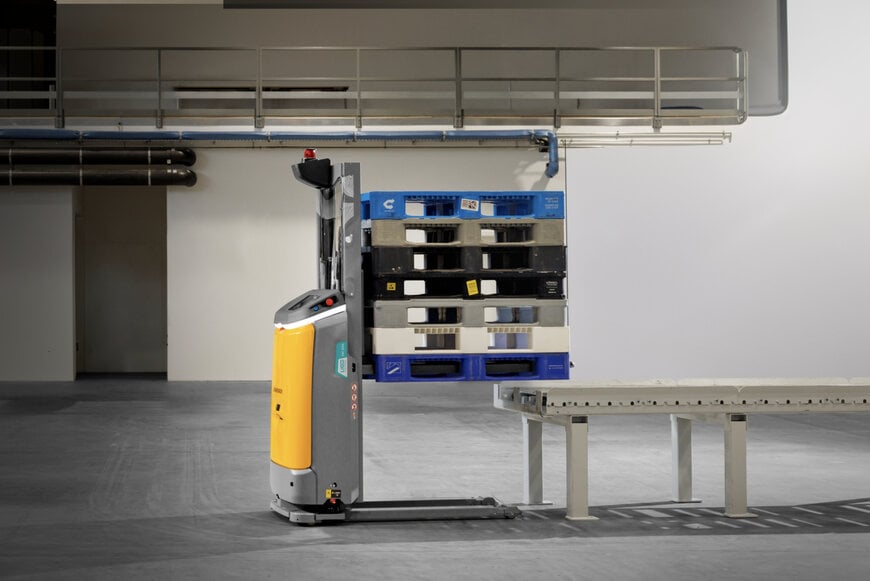
Internal transport between receiving bays, floor storage, active production zones, and shipping docks frequently suffers from throughput bottlenecks and staffing constraints in modern industrial environments. Jungheinrich has commercialized its EAC 212a autonomous mobile robot to establish flexible, infrastructure-free pallet transport links across disparate production and warehousing stages.
Material Flow Integration Across Heterogeneous Warehouse Environments
Conventional internal transport workflows depend heavily on fixed conveyor systems or manual industrial trucks to transfer unit loads across facility zones. Fixed conveyors require significant floor area and high capital expenditure, creating rigid plant layouts that resist later operational changes. Conversely, manual forklift operations face rising labor shortages, variable cycle times, and collision hazards in congested aisles.
The EAC 212a addresses these layout and operational constraints by automating point-to-point horizontal transport and vertical handoffs. Operating across goods receiving, buffer lanes, block storage areas, packaging cells, and automated storage and retrieval systems, the vehicle provides a continuous material link without demanding physical layout restructuring.
Kinematic Performance and Integrated Vertical Lifting Architecture
Unlike standard low-profile autonomous vehicles restricted to floor-level towing or under-load cart transport, the EAC 212a incorporates an integrated lifting mechanism capable of serving transfer heights up to 1,200 millimeters. This capability allows direct pickup and drop-off at elevated roller conveyors, transfer tables, and low-level racking stations without requiring secondary stationary transfer equipment.
The vehicle operates on a bidirectional chassis engineered for tight industrial aisles, handling unit loads up to 1,200 kilograms at travel speeds up to 6 kilometers per hour. Power is supplied by a 25.6-volt, 130-ampere-hour lithium-ion battery system designed for continuous operation through automated booster and opportunity charging routines during operational pauses.
Computer Vision, Obstacle Avoidance, and Autonomous Navigation
The navigation architecture utilizes natural contour-based LiDAR mapping, eliminating artificial floor markers, magnetic tape, or reflective ceiling targets. During initial commissioning, the vehicle scans the facility boundaries to construct a digital environmental reference map.
Operational stability is maintained through a combination of physical sensing and software algorithms:
- Perimeter Safety: A 360-degree safety sensor network monitors the path of travel, identifying stationary and dynamic obstacles starting from 70 millimeters in height to support safe mixed operation alongside plant personnel and manual trucks.
- Load Position Compensation: Camera-based three-dimensional computer vision algorithms inspect incoming load carriers, compensating for lateral alignment deviations of up to plus-or-minus 100 millimeters and angular torsion of up to plus-or-minus 10 degrees.
- Autonomous Error Recovery: Integrated recovery protocols allow the vehicle to execute self-correction maneuvers in the event of temporary trajectory blockages, minimizing the need for manual operator interventions.
Deployment Strategy and Software Standardization
The mobile robot incorporates software functionalities proven in Jungheinrich’s companion EAE 212a platform, including dynamic storage aisle pallet management and variable cycle speed adaptation. To minimize implementation risk, commissioning pathways utilize try-and-buy and on-site demonstration models, allowing industrial operators to validate throughput figures prior to facility-wide rollout.
The system connects to higher-level warehouse management systems (WMS) and enterprise resource planning (ERP) platforms via standard digital interfaces, supporting incremental fleet expansion from a single autonomous unit to complex multi-vehicle fleets.
The EAC 212a was presented at the LogiMAT trade fair in Stuttgart, Germany, held in March 2026.
Additional Context:
This section details technical specifications and competitive benchmarking not included in the original product announcement.
In industrial autonomous mobile robotics, interoperability is heavily governed by the VDA 5050 communication standard, an interface protocol developed jointly by the German Association of the Automotive Industry (VDA) and the VDMA Materials Handling and Intralogistics Association. The EAC 212a architecture adheres to VDA 5050 compliance, enabling control through vendor-agnostic master fleet controllers alongside mobile robots from third-party manufacturers.
Compared to conventional automated guided vehicles (AGVs) governed by ISO 3691-4 industrial truck safety standards, AMRs utilizing natural feature navigation offer lower integration overhead than laser-guided vehicles (LGVs) requiring surveyed wall reflectors. Standard pallet-handling mobile robots in the 1,000-to-1,500-kilogram payload class, such as the MiR1200 Pallet Jack or equivalent counterbalanced AMR units, typically feature fixed ground-level forks or passive pin-towing pins. The EAC 212a's 1,200-millimeter mast lift range allows it to bridge the boundary between horizontal pallet transport and secondary tier buffer handling, directly competing with specialized compact automated stacker trucks while preserving a low turning radius.
Edited by Natania Lyngdoh, Induportals editor, with AI assistance.
www.jungheinrich.com
The mobile robot incorporates software functionalities proven in Jungheinrich’s companion EAE 212a platform, including dynamic storage aisle pallet management and variable cycle speed adaptation. To minimize implementation risk, commissioning pathways utilize try-and-buy and on-site demonstration models, allowing industrial operators to validate throughput figures prior to facility-wide rollout.
The system connects to higher-level warehouse management systems (WMS) and enterprise resource planning (ERP) platforms via standard digital interfaces, supporting incremental fleet expansion from a single autonomous unit to complex multi-vehicle fleets.
The EAC 212a was presented at the LogiMAT trade fair in Stuttgart, Germany, held in March 2026.
Additional Context:
This section details technical specifications and competitive benchmarking not included in the original product announcement.
In industrial autonomous mobile robotics, interoperability is heavily governed by the VDA 5050 communication standard, an interface protocol developed jointly by the German Association of the Automotive Industry (VDA) and the VDMA Materials Handling and Intralogistics Association. The EAC 212a architecture adheres to VDA 5050 compliance, enabling control through vendor-agnostic master fleet controllers alongside mobile robots from third-party manufacturers.
Compared to conventional automated guided vehicles (AGVs) governed by ISO 3691-4 industrial truck safety standards, AMRs utilizing natural feature navigation offer lower integration overhead than laser-guided vehicles (LGVs) requiring surveyed wall reflectors. Standard pallet-handling mobile robots in the 1,000-to-1,500-kilogram payload class, such as the MiR1200 Pallet Jack or equivalent counterbalanced AMR units, typically feature fixed ground-level forks or passive pin-towing pins. The EAC 212a's 1,200-millimeter mast lift range allows it to bridge the boundary between horizontal pallet transport and secondary tier buffer handling, directly competing with specialized compact automated stacker trucks while preserving a low turning radius.
Edited by Natania Lyngdoh, Induportals editor, with AI assistance.
www.jungheinrich.com
