
www.intralogisticsmag.com
22
'26
Written on Modified on
Scaling physical AI solutions for retail and logistics
Teradyne Robotics and Sereact integrate Cortex physical AI software with Universal Robots collaborative arms to automate unstructured returns handling in logistics facilities.
www.universal-robots.com
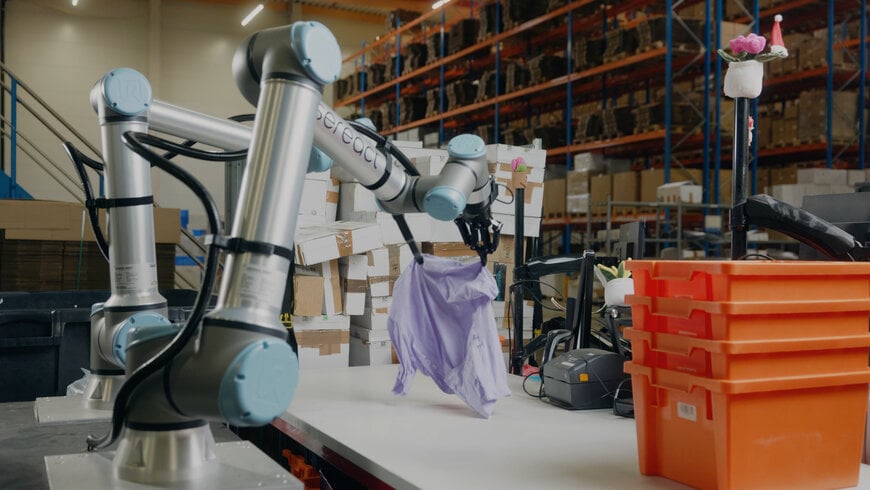
Teradyne Robotics and Sereact have formalized a commercial partnership to deploy physical artificial intelligence systems across retail, logistics, and manufacturing operations. The cooperation interfaces vision-language-action software with multi-axis collaborative robotic manipulators to automate unstructured parcel manipulation, focusing on high-volume reverse logistics and piece-picking.
Operational Complexities in Reverse Logistics
Fulfillment networks face persistent operational bottlenecks in returns processing and secondary item handling. Unlike structured forward picking, returned goods arrive in mixed, unstandardized packaging with unknown orientations and varied material deformability, historically requiring continuous manual sorting. Deterministic industrial automation cannot handle these high-entropy workflows without extensive SKU cataloging and manual teaching. To resolve these constraints, the partnership bridges cognitive perception models with industrial robotic kinematics, enabling autonomous item manipulation without pre-programmed SKU paths.
System Architecture and Control Hierarchy
The joint solution pairs Sereact’s proprietary Cortex physical artificial intelligence platform with Universal Robots UR12e-1300 collaborative arms. Universal Robots, an operating unit of Teradyne Robotics, provides the multi-axis mechanical hardware, high-resolution joint encoders, and real-time safety control buses. Sereact delivers the core software layer, which utilizes a Vision-Language-Action foundation model running inference on edge processors.
The software pipeline receives continuous spatial perception data from optical sensors, identifying object boundaries, surface textures, and grasp points on deformed or bagged items in real time. Cortex translates these high-level perceptual inferences directly into kinematic trajectories and gripper actuations. Because the foundation model operates zero-shot inference across unknown packaging geometries, the unified dual-arm system manipulates novel items without individual model retraining or offline simulation recalibration.
Commercial Deployment and Scalability
The companies demonstrated the joint architecture running on dual UR12e-1300 arms at NVIDIA GTC Berlin 2026. Commercial implementation has moved into active distribution hubs, with hundreds of collaborative robot units deployed across Europe in partnership with CEVA Logistics for online retailer Zalando. At fulfillment facilities located in Greven, Germany, and Swiebodzin, Poland, dual-arm systems autonomously process and sort returned fashion products. Sereact has established an operational headquarters in Boston, Massachusetts, to expand deployment into North American logistics networks.
Target Applications and Warehouse Impact
Target applications encompass store replenishment, order induction, bin consolidation, machine tending, and returns handling. Deploying zero-shot vision-language-action models to collaborative robotics eliminates repetitive manual sorting stations, establishes continuous piece-picking throughput across mixed product flows, and provides a scalable framework for industrial automation.
Edited by Romila DSilva, Induportals Editor, with AI assistance.
www.universal-robots.com
