
www.intralogisticsmag.com
20
'26
Written on Modified on
Automated material handling systems for high-capacity industrial logistics
Linde Material Handling introduces specialized autonomous guided vehicles and humanoid robotics research to enhance efficiency and versatility within the modern digital supply chain.
www.linde-mh.com
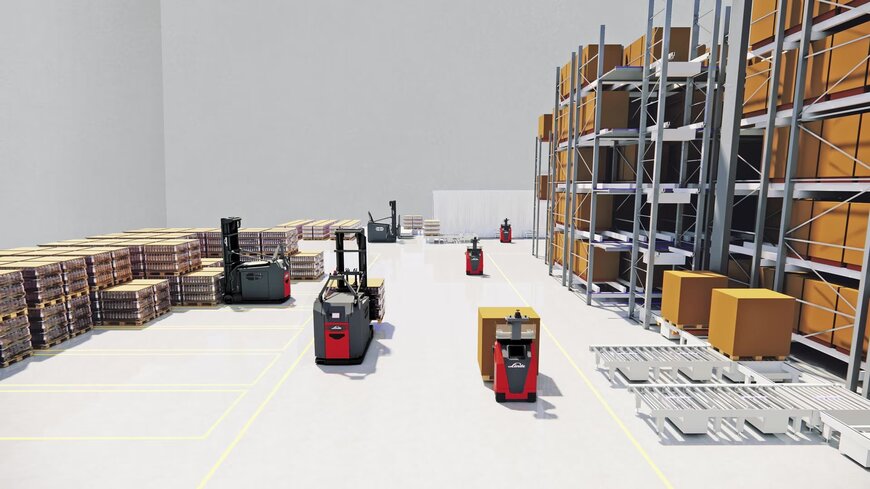
Linde Material Handling (MH) presented its latest advancements in autonomous intralogistics, focusing on high-capacity load handling and the integration of artificial intelligence. These developments address the increasing complexity of the automotive data ecosystem and general industrial warehousing, where precision and heavy-lift capabilities are required for autonomous operations.
High-capacity autonomous guided vehicles
The newly introduced I-MATIC core series represents a shift toward specialized, high-capacity autonomous guided vehicles (AGVs) capable of performing tasks previously reserved for manual operation. These counterbalance vehicles are engineered to manage loads up to 4.0 tons with a 600-millimeter load center of gravity. For high-bay applications, the system maintains a residual capacity of 3.5 tons at lifting heights reaching 6.7 meters.
To meet specific industry requirements, the series supports various technical attachments, including single-double forks for the beverage industry and paper clamps for heavy cylindrical rolls. These AGVs operate on the MATIC:move+ software platform and are integrated via the Linde Warehouse Manager, which coordinates routing, traffic control, and material flow. Furthermore, specialized variants are rated for cold-storage environments with ambient temperatures reaching -25°C.
Integration of embodied AI and humanoid robotics
Beyond conventional AGVs, the company demonstrated a humanoid robot prototype, internally designated as "Carl," to illustrate the trajectory of autonomous order picking. Unlike standard robotic arms that follow fixed coordinate paths, this system utilizes embodied AI to perform independent decision-making during the gripping process.
Through an AI training process, the robot identifies objects—such as specific beverage containers—and determines the optimal path and grip orientation without remote intervention or predefined sequences. While this technology is in the development phase within the KION Group, it builds upon the existing RoCAP system, which currently uses intelligent robotic arms to automate palletizing and picking tasks.
Diversified automation and stationary systems
The current portfolio also includes standardized solutions for space-constrained environments. The L-MATIC core autonomous pallet stacker is designed for narrow-aisle navigation, requiring a width of less than 2.5 meters. For high-density storage, the S-MATIC cube provides a stationary, four-way pallet shuttle system. This self-contained unit utilizes elevators and shuttles to process up to 100 pallets per hour, supporting industrial loads of 1.5 tons.
By expanding the technical parameters of AGVs and investing in autonomous decision-making AI, these systems aim to reduce manual touchpoints in heavy-duty and complex logistics environments.
Edited by Evgeny Churilov, Induportals Media - Adapted by AI.
www.linde-mh.com
