
www.intralogisticsmag.com
26
'26
Written on Modified on
Jungheinrich Showcases Connected Material Flow Systems at LogiMAT 2026
Integrated forklifts, mobile robots, and lithium-ion solutions demonstrate how automated and manual intralogistics processes can be combined for efficient warehouse operations.
www.jungheinrich.co.uk
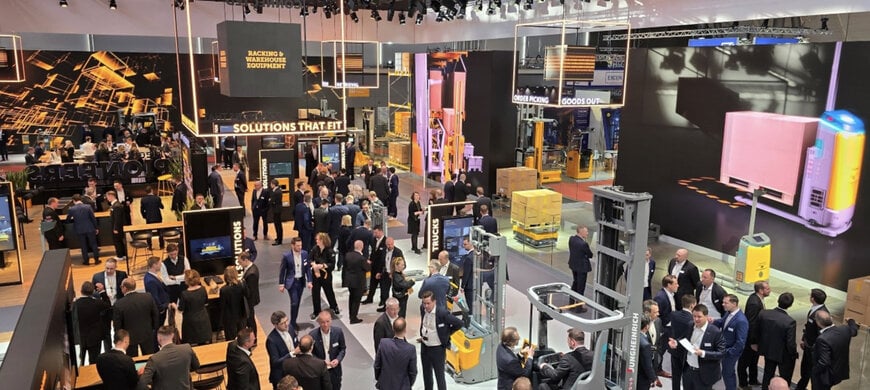
Warehousing, intralogistics, and industrial production sectors increasingly require coordinated automation and manual handling to maintain throughput and flexibility. At LogiMAT 2026 in Stuttgart (24–26 March), Jungheinrich presented a portfolio of connected material handling systems combining electric forklifts, mobile robots, and digital integration concepts to support continuous and scalable material flow.
Integrated systems for connected intralogistics
Jungheinrich structured its exhibition around a “Connected Solutions” approach, focusing on interoperability between manual equipment and automated systems. Across multiple exhibition areas totaling 1,160 m², the company demonstrated how warehouse processes—ranging from pallet transport to high-bay storage—can be linked into a continuous process chain.
Mobile robots shown in Hall 8 were designed to operate alongside manual trucks, reducing repetitive transport tasks and enabling dynamic allocation of resources. These systems rely on integration into existing warehouse environments rather than requiring dedicated infrastructure, which is relevant for facilities upgrading incrementally toward automation.
Electric counterbalance trucks redesigned for confined operations
The new EFG 2/2i and 3/3i electric counterbalance trucks target applications in manufacturing logistics, distribution centers, and confined warehouse layouts. Designed for load capacities up to two tonnes, the trucks feature a compact chassis that improves maneuverability in narrow aisles and production zones.
Three configurable performance variants allow adaptation to different duty cycles, such as intermittent indoor transport or continuous multi-shift operation. Operator-focused improvements include enhanced visibility, reduced vibration exposure, and updated assistance systems, contributing to safer handling and reduced fatigue during extended use.
High-bay handling with increased lifting performance
For high-bay warehouse operations, Jungheinrich introduced the ETV 4i reach truck, engineered for high-throughput environments such as distribution hubs and automated storage facilities. The system achieves lifting speeds of up to 1.5 m/s (without load) using its liftingPRO system, positioning it among the fastest in its class.
The integration of lithium-ion battery technology enables opportunity charging, allowing operators to recharge during short breaks without removing the battery. This supports continuous operation while reducing downtime and maintenance requirements compared to conventional lead-acid systems. The compact design also contributes to improved storage density by enabling tighter aisle configurations.
High-voltage electric platform for heavy-duty applications
A key development presented was the FalcOn high-voltage system, designed for heavy-duty counterbalance trucks operating under demanding conditions such as outdoor logistics yards, steep gradients, and high-load handling.
Based on the EFG 5 series platform, this system demonstrates how high-voltage electric drivetrains can replace internal combustion engines in applications traditionally dominated by diesel or LPG trucks. The focus is on delivering sufficient torque and endurance for continuous operation while reducing emissions and simplifying maintenance requirements.
Autonomous mobile robot for high-lift material handling
In the automation segment, the EAC 212a mobile robot addresses high-lift pallet transport in warehouses and production facilities. The system supports automated storage and retrieval up to a handover height of 1,200 mm, enabling integration into existing racking systems.
AI-based 3D pallet detection allows reliable handling in mixed environments where manual and automated vehicles operate simultaneously. The robot uses contour-based navigation, eliminating the need for floor markers or structural modifications, which simplifies deployment in brownfield facilities. This approach supports gradual automation while maintaining operational continuity.
Positioning within the intralogistics market
Jungheinrich’s approach aligns with broader industry trends toward hybrid intralogistics systems that combine automation with human-operated equipment. Comparable solutions exist from manufacturers such as KION Group and Toyota Material Handling, which also offer integrated fleets of electric trucks and autonomous mobile robots.
However, differentiation in this segment typically depends on system interoperability, energy management strategies—particularly lithium-ion integration—and the ability to retrofit automation into existing warehouse environments. Jungheinrich’s emphasis on contour-based navigation and modular system integration reflects these priorities.
By presenting a full spectrum of equipment—from entry-level trucks to high-voltage heavy-duty systems—within a unified connectivity framework, the company highlighted how intralogistics operations can transition incrementally toward higher levels of automation while maintaining flexibility.
Edited by Natania Lyngdoh, Induportals Editor — Adapted by AI.
www.jungheinrich.com
