
www.intralogisticsmag.com
15
'26
Written on Modified on
Integrated Logistics Automation Systems for Warehouse Operations
Comau and Automha present a modular automation portfolio combining AI-driven warehouse software, autonomous transport, and high-density storage technologies.
www.comau.com
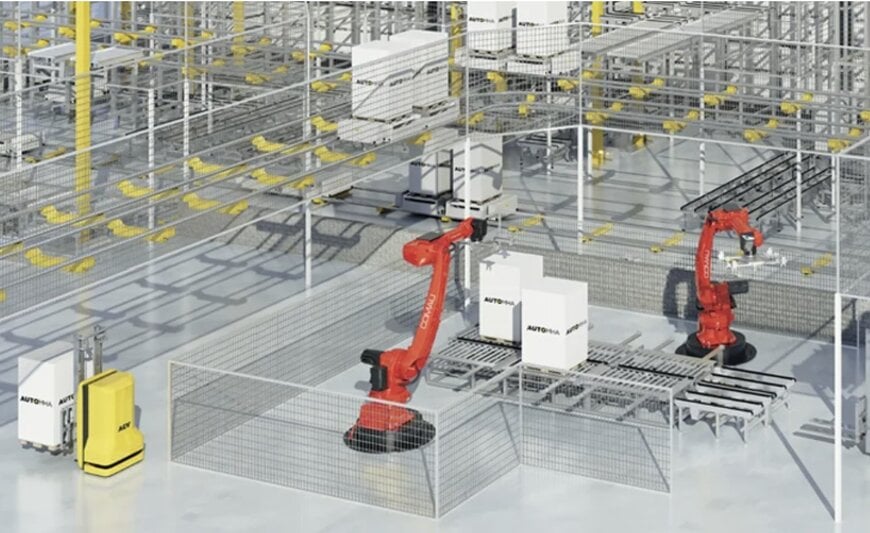
Warehouse operators are increasingly adopting integrated automation systems to manage throughput, storage density, and labor efficiency across complex logistics environments. In this context, a joint portfolio combining software orchestration, storage automation, and mobile robotics was presented by Comau and Automha at MODEX 2026.
End-to-end automation across the logistics flow
The solutions were showcased at MODEX 2026, held from April 13 to 16 in Atlanta, Georgia, targeting industries such as e-commerce, third-party logistics (3PL), and manufacturing logistics. The combined system architecture addresses the full warehouse lifecycle, including goods receiving, storage allocation, automated retrieval, order picking, and shipping synchronization.
This approach reflects a broader shift toward the digital supply chain, where software orchestration and physical automation systems operate as a unified layer. The integration supports coordinated workflows and reduces system fragmentation by linking warehouse management, material handling, and transport systems within a single operational framework.
AI-driven warehouse management and operational visibility
A central component of the system is NOVA AI, integrated into Automha’s AWMS (Automha Warehouse Management System). The system uses real-time facility data to interpret operational states, detect anomalies, and support decision-making.
Built on a multi-agent architecture, NOVA AI enables contextual analysis of warehouse events through a conversational interface. This reduces the need for manual data queries and shortens response times when addressing disruptions or inefficiencies. In practice, this supports faster diagnostics in high-throughput environments where delays can propagate across multiple process stages.
Multidirectional shuttle system for dense storage environments
Automha’s Quaterways system introduces a multidirectional shuttle mechanism capable of moving both along aisles and orthogonally into storage channels. This differs from conventional shuttle systems that typically require transfer points or operate along fixed paths.
The system is designed for automated storage and retrieval operations in high-density configurations. Its ability to handle multiple pallet formats within the same channel and dynamically optimize routing contributes to reduced cycle times and improved storage utilization.
By eliminating the need for dedicated transfer systems, Quaterways simplifies warehouse layout design while maintaining continuous shuttle operation. This is particularly relevant in environments with variable inventory profiles, such as e-commerce fulfillment centers.
Deep-lane storage systems with global deployment
The Pallet Runner GTR and Pallet Runner 4D systems extend Automha’s shuttle-based storage technology for deep-lane pallet handling. With more than 12,500 units deployed across 79 countries, these systems support high-density storage while maintaining compatibility with standard racking systems and forklifts.
Their modular configurations allow adaptation to different pallet sizes and load types, enabling deployment in both new facilities and retrofit projects. This flexibility supports gradual automation upgrades without requiring full infrastructure replacement.
Autonomous mobile robots for flexible material transport
Comau’s MyMR autonomous mobile robots, developed in collaboration with Milvus Robotics, address intra-logistics transport between storage zones, workstations, and production lines.
The system operates without fixed infrastructure, using flexible navigation and fleet management to coordinate multiple units. This enables rapid deployment and scalability, particularly in facilities where layouts may change over time.
Advanced safety systems allow these robots to operate alongside human workers and existing equipment, supporting hybrid workflows. The infrastructure-free design reduces installation complexity and supports faster return on investment in dynamic warehouse environments.
Wearable robotics for manual task support
In addition to automation systems, Comau presented the MATE-XT GO exoskeleton, designed to assist operators performing repetitive or physically demanding tasks.
The device reduces shoulder strain during activities such as truck unloading, manual sorting, and material handling. By improving operator ergonomics, it complements automated systems in workflows where full automation is not feasible, contributing to sustained productivity and reduced fatigue.
Modular automation aligned with logistics growth
The integrated portfolio reflects increasing demand for scalable automation systems in warehouse operations, where annual market growth is projected to exceed 10%.
By combining warehouse management software, AI-based analytics, storage automation, and autonomous transport, the system supports a modular transition toward fully automated logistics environments. This architecture enables operators to incrementally expand automation capabilities while maintaining operational continuity across the supply chain.
Edited by Aishwarya Mambet, Induportals Editor, with AI assistance.
www.comau.com
