
www.intralogisticsmag.com
22
'26
Written on Modified on
Li-ion battery safety in intralogistics
Jungheinrich validates the safety of its LFP batteries through fire tests conducted by CNPP.
www.jungheinrich.co.uk
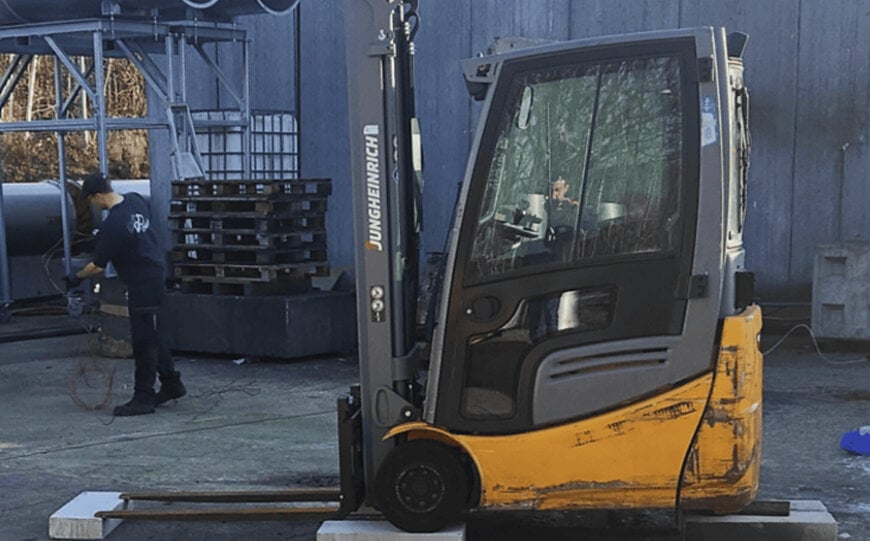
In response to ongoing concerns about the indoor use of lithium-ion-powered material handling equipment, Jungheinrich commissioned CNPP to carry out fire tests on a forklift truck. The objective was to provide factual data to assess real risks and address common misconceptions surrounding Li-ion technology.
Realistic fire testing conditions
The test was conducted on a counterbalanced forklift model EFG 215 equipped with a 390 Ah lithium iron phosphate (LFP) battery. The scenario simulated a warehouse fire by placing gas burners beneath the vehicle, directly near the battery.
This setup reproduced extreme conditions to evaluate the battery’s behavior in a real fire scenario, particularly regarding fire propagation, degassing, and overall safety.
Reassuring safety results
The tests confirmed that there was no explosion and no projection of material from the battery. The observed degassing did not intensify the fire and occurred after approximately 48 minutes, providing sufficient time for emergency response.
Measurements also showed that the fire intensity associated with the battery remained lower than that generated by other components of the vehicle, such as the cabin or hydraulic fluids. Temperature readings confirmed that the battery was not the primary contributor to fire escalation.
LFP technology and safety-focused design
Unlike many lithium-ion batteries that contain cobalt, Jungheinrich’s batteries are based on lithium iron phosphate (LFP) chemistry, known for its higher thermal stability and safer behavior under stress.
The design also includes a battery management system (BMS) capable of shutting down the battery in case of risk, enhancing safety during both operation and charging.
Additionally, the mechanical construction of the battery—adapted to the requirements of industrial trucks—features a robust housing that further improves fire resistance.
Results applicable across the product range
Although the test was conducted on a single model, the design of Jungheinrich’s Li-ion batteries—including chemistry, cell configuration, and mechanical protection—is consistent across the entire range.
As a result, the fire behavior observed can be considered representative of all Jungheinrich Li-ion batteries, providing valuable reassurance for users and insurers.
Supporting broader adoption of Li-ion technology
These tests contribute to a clearer understanding of the actual risks associated with Li-ion batteries in industrial environments. They demonstrate that, when properly designed and implemented, these solutions can offer high safety levels while supporting the transition toward more efficient and sustainable material handling systems.
Edited by Maria Brueva, Induportals editor – adapted by AI.
www.jungheinrich.com
