
www.intralogisticsmag.com
28
'26
Written on Modified on
KUKA Launches KMF 1500P-CB Autonomous Counterbalance Forklift
KUKA introduces the KMF 1500P-CB autonomous forklift, inaugurating its KMF 1500P series to automate flexible material handling and pallet transport.
www.kuka.com
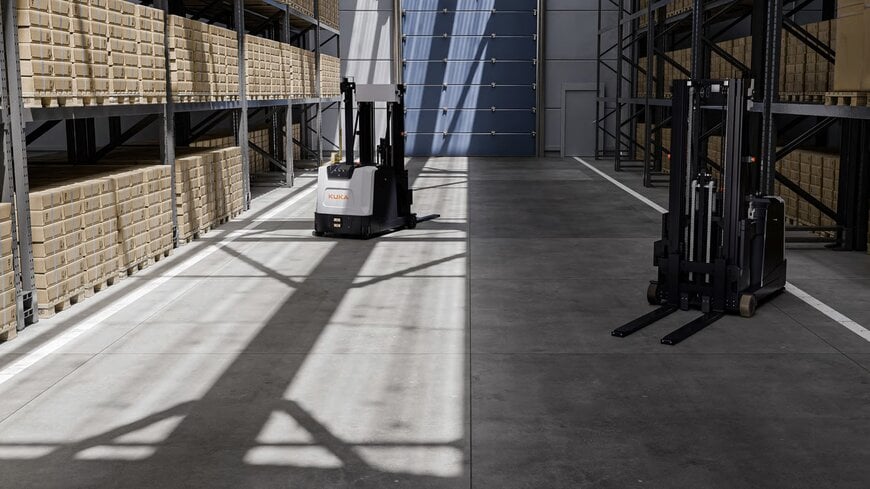
KUKA has launched the KMF 1500P-CB, marking the first model in its new KMF 1500P series of autonomous forklifts developed to automate intralogistics material flows and manage pallet transport across warehouses and manufacturing operations. The system operates autonomously to replace manual material handling, addressing labor shortages and optimizing logistics resource efficiency.
Load Capacities and Counterbalance Architecture
The KMF 1500P-CB is engineered with a counterbalance configuration ("CB") that allows it to interact directly with both open and closed pallets as well as containers weighing up to 1,500 kilograms. The cantilevered counterbalance design enables load pickup and deposition at enclosed transfer stations—including driven roller conveyor lines—without requiring structural modifications to existing factory interfaces.
The vehicle incorporates enlarged wheels to maintain transit stability and transport efficiency across longer routing distances within facilities. Onboard sensing supports automated load detection, engagement, and precise lifting up to heights of three meters.
Power Architecture and Continuous Operation
Electrical energy is provided by lithium iron phosphate (LFP) battery chemistry integrated with conductive automated charging interfaces. The power delivery and fast-charging setup support continuous 24/7 operational cycles across production logistics networks.
Additional Context
This section details technical specifications not included in the original news release.
Autonomous counterbalance forklifts deployed in industrial intralogistics typically utilize natural feature navigation—frequently combining 2D/3D safety LiDAR Simultaneous Localization and Mapping (SLAM) with ceiling-facing optical cameras—eliminating the requirement for floor-mounted magnetic tapes or reflective triangulation targets. Fleet management software platforms coordinate automated guided vehicles (AGVs) and autonomous mobile robots (AMRs) using standardized VDA 5050 communication protocols over industrial Wi-Fi or private 5G networks, enabling dynamic mission allocation, traffic routing, and battery charging thresholds. Lithium iron phosphate (LFP) energy systems offer thermal stability and high cycle durability, regularly achieving 3,000 to 5,000 charge cycles while supporting opportunity charging rates up to 1C at stationary copper charge pads. Personnel safety architectures are certified to ISO 3691-4 standards for driverless industrial trucks, deploying Category 3 / PL d functional safety laser scanners with dynamic, speed-dependent protective field switching alongside 3D time-of-flight (ToF) cameras on the mast carriage to detect low-profile floor debris and overhang clearances during pallet handling.
Edited by Romila DSilva, Induportals Editor, with AI assistance.
www.kuka.com
